
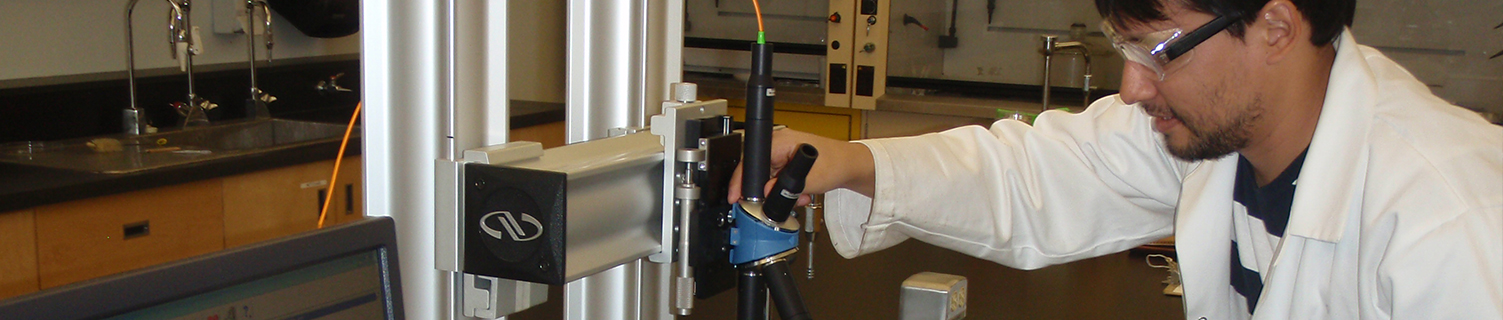
Outstanding participation of our members at the CSCE 2026 conference in Quebec!
Several members of our team, namely Alexander Salenikovich, Félix Coulaud, Christopher Gagnon, Kiavash Gholamizoj, and Ahmed Hassan, actively participated in the 2026 annual conference of the Canadian Society for Civil Engineering (CSCE), held from June 3 to 5, 2026, in Quebec City. This major scientific event is one of the leading national gatherings in civil engineering, bringing together researchers, professionals, students, and industry partners around contemporary challenges related to the design, sustainability, and performance of infrastructure.
In a context where the decarbonization of the construction sector and the increased use of engineered wood play a strategic role, our team’s participation highlighted advanced research work while strengthening collaborations with the Canadian and international scientific community.
A strong scientific presence in sessions on timber structures
Our team members made significant contributions to the three thematic sessions dedicated to timber structures:
- Wednesday, June 3, 2026 (10:30 a.m. – 12:15 p.m.): ST4 – Wood Structures I
- Thursday, June 4, 2026 (3:45 p.m. – 5:30 p.m.): ST19 – Wood Structures II
- Friday, June 5, 2026 (2:00 p.m. – 3:45 p.m.): ST27 – Wood Structures III
These sessions covered a wide range of topics, including advanced mechanical behavior of wood, the performance of connections, innovative experimental methods, and large-scale structural applications. Our team’s involvement was distinguished not only by the number of scientific contributions but also by leadership roles within the technical sessions.
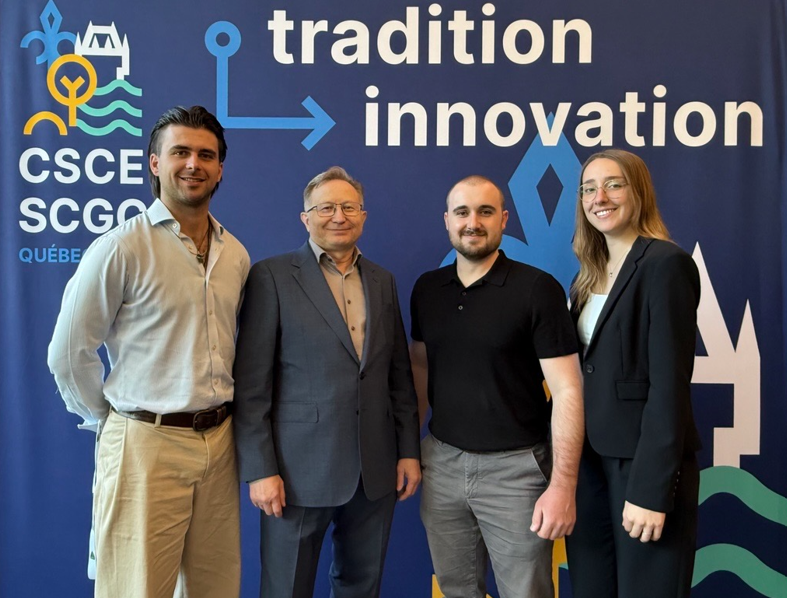
- Professor Alexander Salenikovich played a central role in the scientific program, serving as co-author of eight presentations, lead author of one paper, and chair of a technical session. This sustained involvement reflects his commitment to organizing and facilitating scientific exchanges, as well as to the dissemination of knowledge in timber engineering. His paper, titled « Restoring the Original Intent of Yield Equations for Dowel-Type Fasteners in CSA O86 », highlights inconsistencies in current formulations that may lead to design errors. He proposes a reformulation aimed at restoring the model’s original logic and improving the accuracy of calculations.
- Félix Coulaud presented two papers as lead author, focusing on the performance of timber structures and the optimization of connection systems. The first, titled « Structural Characterization of White Pine Sandwich Beams for Log Wall Systems – Part 1: Flexural Behavior Characterization», addresses the bending behavior of white pine sandwich beams used in wall systems. Based on experimental tests and analytical models, the study characterizes their bending stiffness and strength while analyzing the influence of bond quality between layers. The results provide an initial basis for the mechanical characterization of these elements and confirm their potential for wall systems that are both high-performing and insulating. The second paper, « Structural Characterization of White Pine Sandwich Beams for Log Wall Systems – Part 2: Characterization of Screw-Connected Beam Assemblies », focuses on the behavior of assemblies of these beams connected by screws. The study highlights the key role of these connections in load transfer. Experimental tests were used to evaluate their stiffness, strength, and load–slip behavior as a function of screw characteristics. The results improve the understanding of the overall behavior of walls and provide essential data for the modeling and optimization of these systems.
- Christopher Gagnon, for his part, contributed to a presentation on the reinforcement of glued-laminated timber connections using self-tapping screws (« Reinforcement of Dowel-Type Glulam Connections Loaded Parallel to the Grain Using Self-Tapping Screws »). The study highlights the brittle behavior of certain connections and demonstrates that adding STS screws significantly improves ductility and energy dissipation. The experimental results also show an increase in load-bearing capacity and a delay in failure due to the development of plastic deformations, thereby contributing to improved safety and the evolution of CSA O86 standard.
- Kiavash Gholamizoj, in collaboration with Alexander Salenikovich, presented a study on the seismic performance of timber braced frames with dowel-type connections (« Energy-Based Damage Assessment of Timber Braced Frames with Dowel-Type Fasteners»). Using an energy-based damage index and nonlinear analyses, the results indicate a low probability of collapse and generally moderate damage levels, confirming the suitability of these systems for moderate seismic regions in Canada.
-
Ahmed Hassan, in collaboration with Luca Sorelli, presented a paper titled « Strengthening Optimisation of Continuous RC Structures (525) », focusing on the optimization of the strengthening of continuous reinforced concrete beams exposed to aggressive environments. The study proposes a hybrid solution combining R-UHPFRC in negative moment regions and the UHP-FRCM system in positive moment regions. Finite element models and design charts demonstrate that this approach increases load-bearing capacity while preserving structural ductility.L’ensemble de ces contributions témoigne de la vitalité de la recherche menée au sein de l’équipe et de sa reconnaissance au sein de la communauté scientifique internationale. For more details about this conference, please consult: https://www.xcdsystem.com/cscec/program/GfzsnF5/index.cfm?pgid=489
Technical visit to CRMR and interdisciplinary exchanges
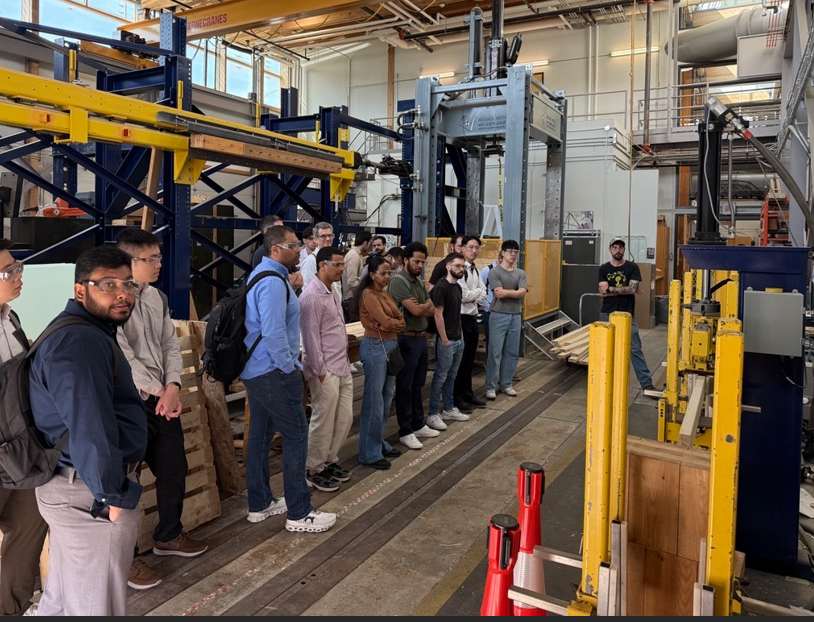
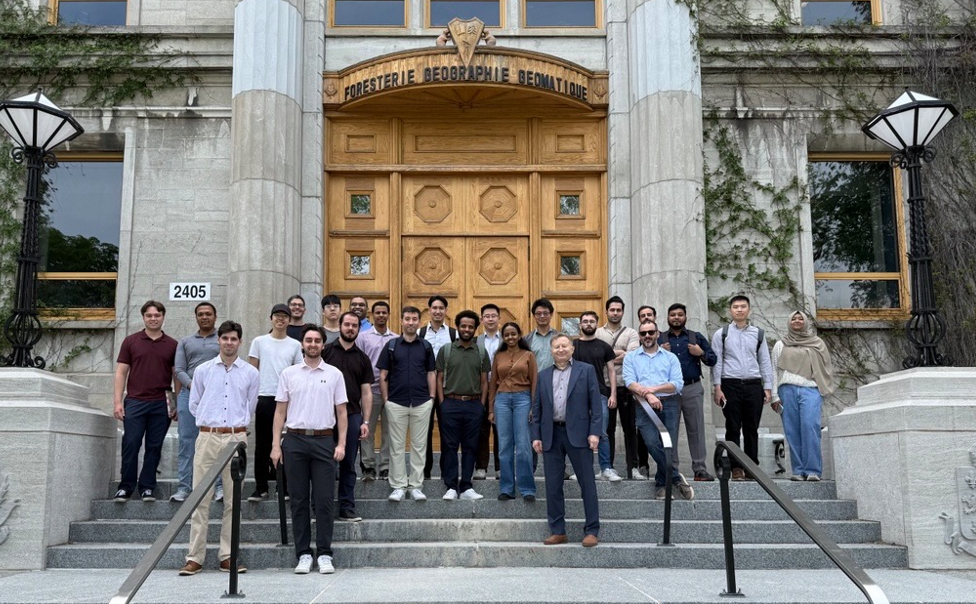
On the sidelines of the conference, a technical visit was organized on June 4 at the CRMR center. This activity brought together a group of professors and students from several renowned institutions, including McGill University, Queen’s University, the University of Waterloo, and the University of Northern British Columbia, as well as the Canadian Wood Council, for a total of approximately 25 participants.
This visit made it possible to discover experimental facilities dedicated to research on renewable materials and timber structural systems, while fostering interdisciplinary exchanges between researchers and students. During this activity, several experimental demonstrations were presented in the laboratory.
Coralie Offroy presented her research project as well as the results of a destructive test carried out as part of her master’s degree, highlighting failure mechanisms in timber structural assemblies. She also demonstrated the behavior of a nailed assembly tested in a mechanical laboratory, illustrating the phenomena of slip, stiffness, and energy dissipation specific to this type of connection.
Two additional tests were conducted at the structural laboratory on sawn timber recovered after a forest fire. These tests were carried out by Samuel Lapierre as part of research on the quality of structural lumber originating from natural disturbances, led by Isabelle Duchesne, a research scientist at Natural Resources Canada. The purpose of these tests was to better understand the residual mechanical properties of post-fire wood—an issue that is becoming increasingly relevant in the context of intensifying climate-related disturbances.
Visits to iconic timber sites and structures
The technical activities continued with field visits allowing participants to observe major timber structural works. The groups notably visited the TELUS Stadium– Université Laval as well as the PEPS sports complex of Université Laval. These infrastructures provided a concrete opportunity to observe the application of timber structural design principles in complex works, combining mechanical performance, structural efficiency, and architectural integration. They also highlighted the growing role of wood in large-scale public infrastructure projects.
Conclusion
The participation of our members in the CSCE 2026 conference and associated activities helped strengthen the visibility of ongoing work, deepen scientific collaborations, and actively contribute to discussions on the future of timber structures in Canada. Beyond scientific presentations, these activities also promoted knowledge transfer between institutions, the training of the next generation of students, and the consolidation of research networks in a rapidly evolving field. This participation confirms our team’s continued commitment to research excellence, the development of sustainable structural solutions, and the advancement of knowledge in timber engineering.
by : Besma Bouslimi