
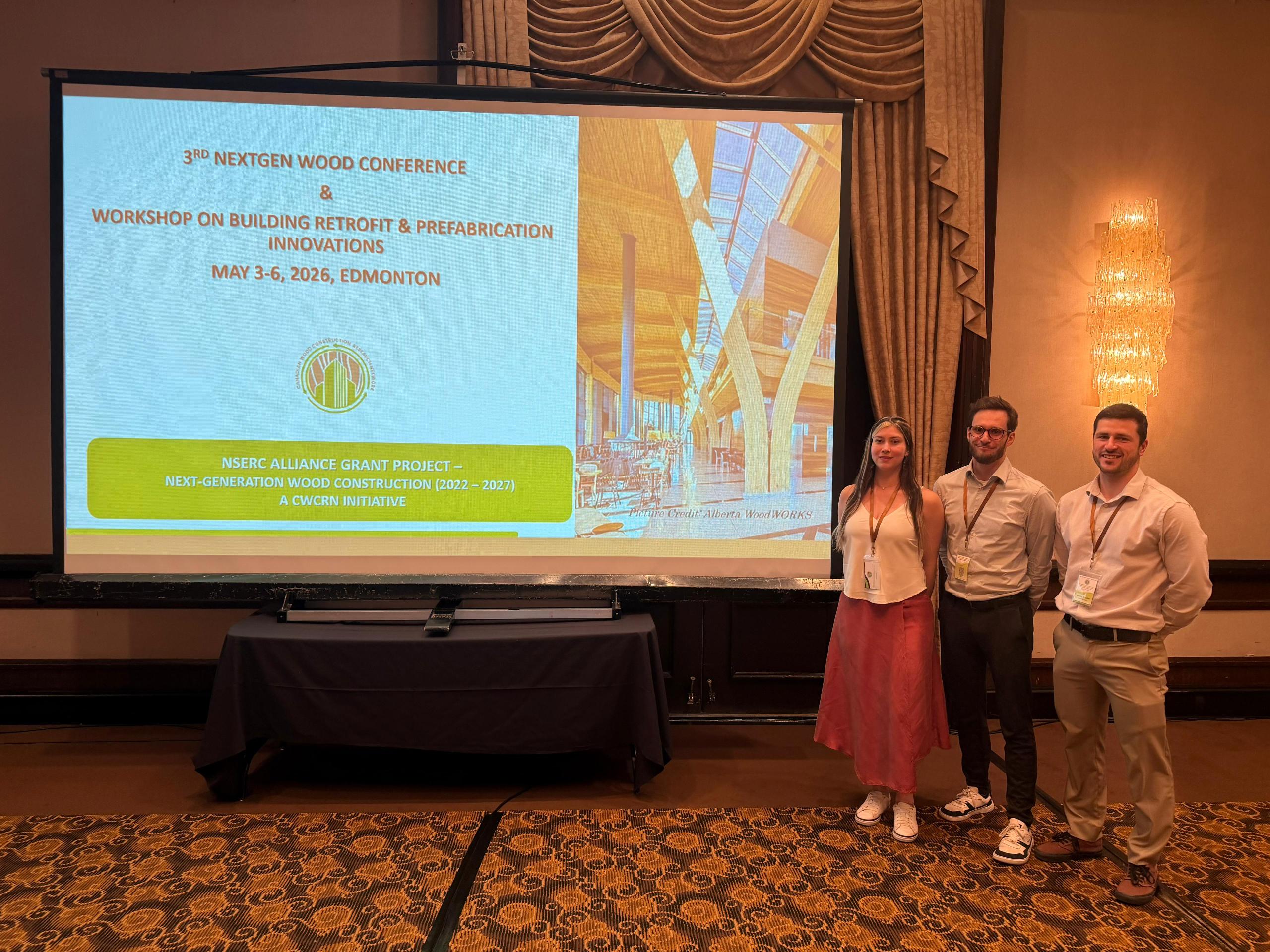
Antony Beaulieu, Isabel Cristina Gomez Garcia and Luc Girompaire at the heart of the 3rd NextGen Wood Conference 2026: Innovation in wood construction!
Antony Beaulieu, Isabel Cristina Gomez Garcia, and Luc Girompaire participated in the 3rd NextGen Wood Conference 2026, held from May 3 to 6 at the Château Lacombe in Edmonton, as part of the initiatives of the Canadian Wood Construction Research Network (CWCRN). This international event highlighted advances in wood engineering, prefabrication, and building energy performance.
During the event, the three researchers stood out for the quality and relevance of their contributions, illustrating the dynamism of research and innovation in wood construction, while strengthening the visibility of their expertise within the scientific and professional community.
Isabel Cristina Gomez Garcia presented her doctoral research conducted under the supervision of Pierre Blanchet, focusing on integrating environmental footprint considerations into the design of wood buildings. Her presentation emphasized the need to move beyond traditional approaches centered solely on energy performance or technical requirements, in order to systematically integrate environmental indicators from the earliest design stages. She notably presented the development of an environmental assessment model adapted to the Canadian context, aimed at rigorously measuring the environmental footprint of wood buildings, with particular attention to embodied carbon. This model is based on a multicriteria approach combining life cycle assessment, environmental impact matrices, numerical simulations, and comparative evaluation methods. It also relies on an in-depth review of recognized standards and certifications such as LEED, BOMA BEST, and the National Energy Code for Buildings. Through this work, she highlighted the importance of an integrated building envelope design approach, which not only optimizes thermal performance and energy efficiency but also significantly reduces greenhouse gas emissions over the entire life cycle. Her approach aims to fill current gaps in the National Building Code of Canada regarding environmental integration, while providing a practical tool to guide practices toward low-carbon solutions. Her presentation demonstrated that integrating these tools at the design stage is a key lever for positioning wood construction as a central solution in the transition toward sustainable and resilient buildings. (Learn more about her research via the provided link.)
Under the supervision of Christian Dagenais, Antony Beaulieu presented his master’s research on the characterization of wood charring rates under realistic fire conditions, a crucial issue for the safety of mass timber structures. His presentation highlighted the limitations of current design approaches, which are generally based on constant charring rates derived from standardized tests that do not account for the thermal and ventilation conditions of real fires. Through a multi-scale experimental program combining small-scale laboratory tests and intermediate-scale tests on cross-laminated timber (CLT) panels, he demonstrated that the charring rate varies significantly depending on incident heat flux and oxygen concentration. The results notably show a logarithmic increase in charring rate with heat flux intensity, as well as a linear decrease when oxygen concentration drops. Based on these observations, he proposed an empirical equation allowing more accurate estimation of charring depth under realistic fire conditions. This approach provides better agreement with experimental results and opens the door to performance-based design methods that more accurately reflect the real behavior of wood in fire situations. His work thus contributes to improving the precision of calculation models and supporting the safe and increased use of exposed timber in modern construction. (Read more about his project via the provided link)
Luc Girompaire presented his expertise in advanced construction processes and prefabrication, focusing on the fire performance of modern connections in mass timber, particularly the increasingly used concealed joints in North America. His doctoral research, conducted under the supervision of Christian Dagenais and Alexander Salenikovich, examines the influence of geometric parameters and wood grain orientation on charring propagation in assemblies. Based on a rigorous intermediate-scale experimental program, he studied key parameters such as the width of gaps between elements and grain orientation on thermal propagation and charring penetration. The results show that increasing gaps between elements leads to greater char penetration within joints, which can affect the overall performance of connections in fire conditions. Furthermore, longitudinal configurations exhibit more extensive charring than transverse configurations, highlighting the decisive role of construction detailing in joint design. These findings reveal limitations in current North American design models while confirming their potential for improvement. They contribute to a better understanding of thermal degradation mechanisms in mass timber connections and to the development of more accurate and high-performing design methods. By integrating these advances into prefabrication practices, this approach enhances the quality, safety, and reproducibility of structural elements while supporting the large-scale deployment of wood-based solutions in a sustainable and industrialized construction context. (For more information about his project, see the provided link.)
Supported by the student mobility assistance program of the CRMR, the participation of Antony Beaulieu and Luc Girompaire in this international event provided a valuable opportunity for scientific development and academic visibility. It also helped showcase the excellence of their institution and the significant contribution of their work to advances in wood construction and performance engineering.
The 3rd NextGen Wood Conference 2026 brought together researchers, engineers, decision-makers, and industry stakeholders for technical sessions and workshops dedicated to innovations in wood construction, prefabrication, sustainable renovation, and reducing the carbon footprint of buildings. Beyond its scientific program, the event served as a strategic networking platform, fostering direct exchanges between academic, industrial, and institutional sectors. These interactions helped strengthen existing collaborations, initiate new ones, and generate prospects for innovative projects at various scales.
In this context, the conference confirms the central role of wood as a key material in the transition toward sustainable, low-carbon construction. By highlighting work such as that of Antony Beaulieu, Isabel Cristina Gomez Garcia, and Luc Girompaire, the event illustrates the importance of interdisciplinary research and collaboration among stakeholders to accelerate innovation and support the development of high-performance and sustainable building solutions.
Congratulations to Antony, Isabel, and Luc for their outstanding participation in this internationally renowned conference and for the excellence of the work they presented.