
A notable Quebec contribution at the international Biogeomon 2026 conference in Sweden!
Evelyne Thiffault and Antoine Harel recently participated in the international Biogeomon conference, held in Umeå, Sweden, from June 8 to 11, 2026. This major event brings together specialists from around the world working on the study of biogeochemical cycles and the interactions between terrestrial ecosystems and global change.
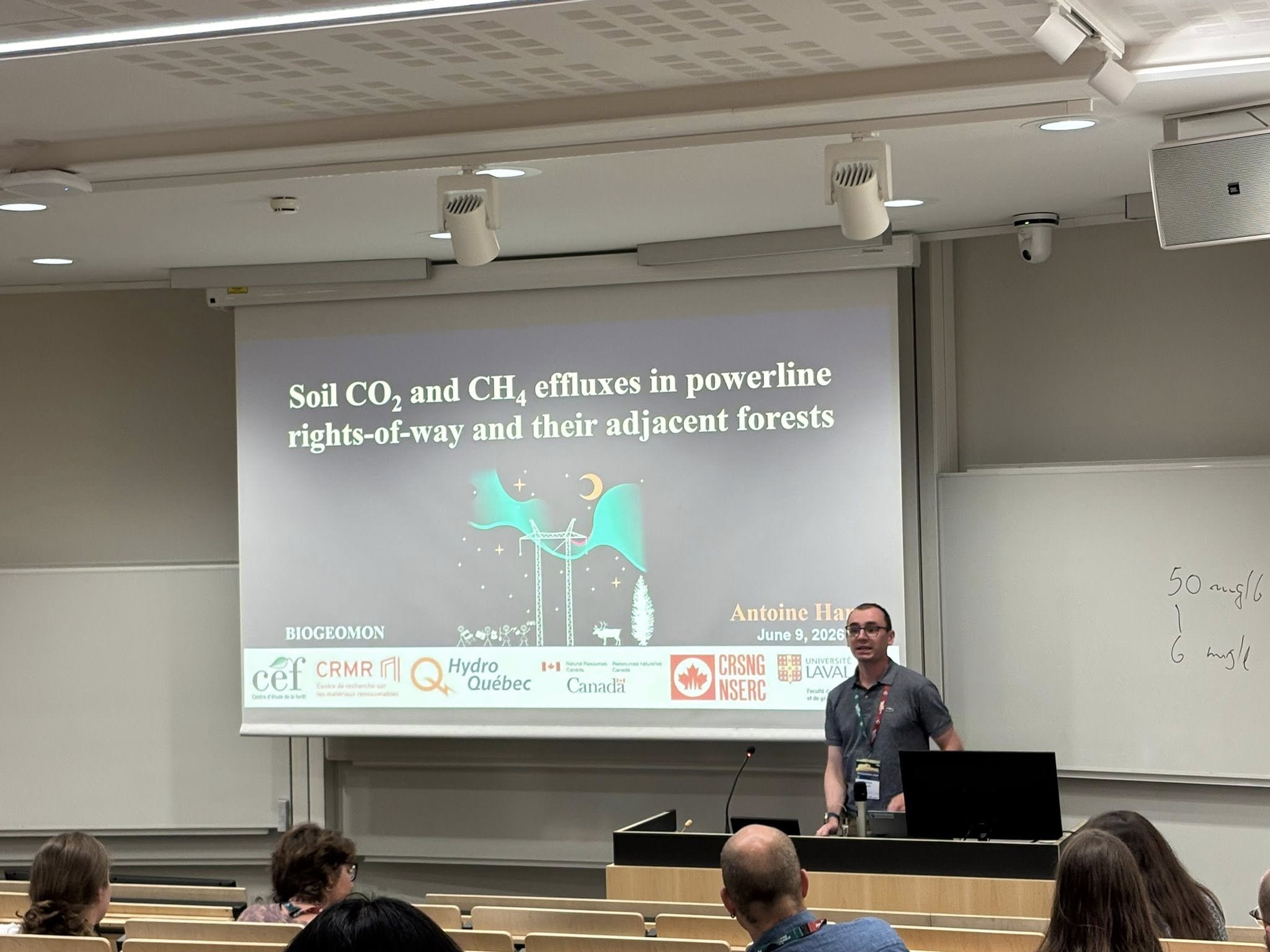
On this occasion, Evelyne Thiffault presented a talk entitled « Assessing future trajectories of Quebec forests with the tEFISCEN-Space model ». This presentation is part of the work carried out during her research stay at Wageningen University in the Netherlands. She presented preliminary results of the validation of the EFISCEN-Space model applied to Quebec forests, a carbon cycle simulation model originally designed for European forests. Her work highlights the relevance and strong potential of this model in a North American context, particularly for simulating the evolution of forest carbon stocks under various management scenarios. Furthermore, this research opens the way to structured comparisons with the Canadian Forest Sector Carbon Budget Model, contributing to strengthening and refining decision-support tools for sustainable forest management and climate change mitigation.
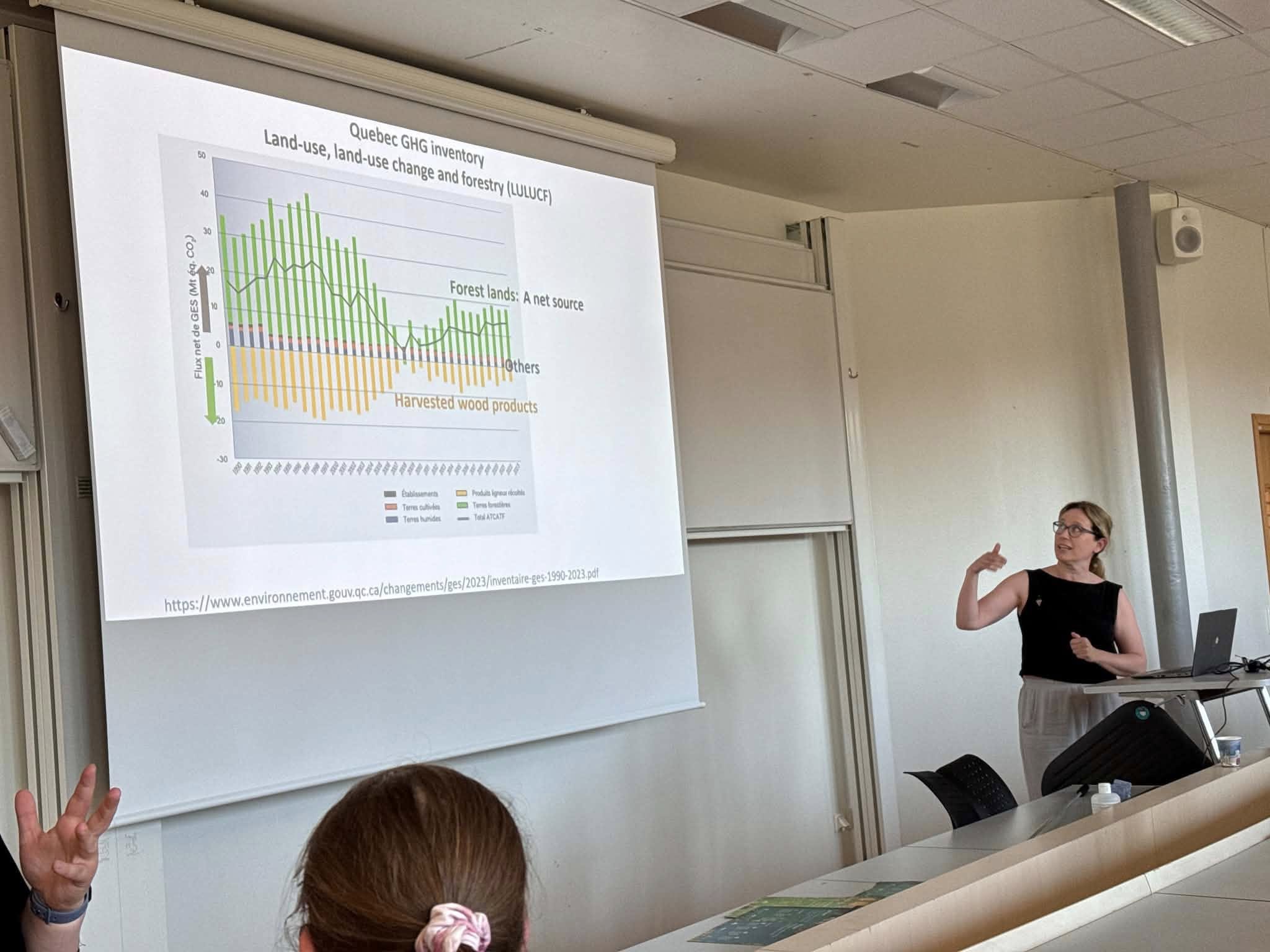
For his part, Antoine Harel presented a talk entitled « Soil CO₂ and CH₄ effluxes in powerline rights-of-way and their adjacent forests », focusing on the effects of powerline corridors on forest soil carbon dynamics. In a global context marked by the energy transition and the need to expand electricity transmission infrastructure, these rights-of-way represent a form of land-use change that is still poorly documented. The main objective of his study was to assess variations in soil carbon dioxide (CO₂) and methane (CH₄) fluxes, as well as changes in microclimatic conditions (soil temperature and moisture), between rights-of-way, adjacent forest edges, and reference forests. Data were collected monthly between May and October 2023 and 2024 across eight sites distributed along a bioclimatic gradient covering temperate and boreal forests of eastern Canada. The results indicate that cumulative soil CO₂ emissions are, on average, lower in rights-of-way (–7.57%) and higher in forest edges (+11.20%) compared to reference forests. However, these trends vary according to bioclimatic regions, with balsam fir forests showing a different response. The study also reveals that soils in rights-of-way are generally warmer and wetter, with no notable effect on methane uptake. These observations highlight the combined influence of abiotic and biotic factors on carbon emissions and emphasize the importance of integrating these dynamics into the assessment of the carbon footprint associated with the deployment of electricity networks.
The participation of Evelyne Thiffault and Antoine Harel in the Biogeomon conference demonstrates both the importance, quality, and international reach of research conducted in Quebec in forestry and environmental sciences. It also highlights the active role of Quebec researchers in advancing knowledge on global change, developing solutions for sustainable forest ecosystem management, and strengthening international scientific collaborations.
For more details on the 12th international Biogeomon conference, you can consult the official SLU – BIOGEOMON2026 website or read the Nordic Forest Research documentation.