
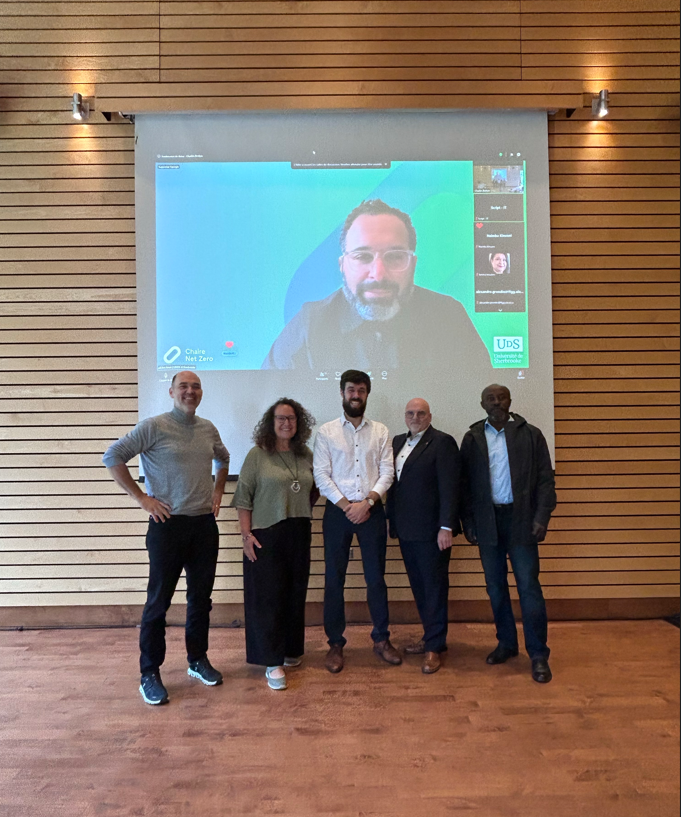
Congratulations to Charles Breton on successfully defending his doctoral dissertation!
Congratulations to Charles Breton, who successfully defended his doctoral thesis in Wood Engineering and Bio-Based Materials on September 14, 2026.
Titled « Characterization of Sustainable Building Solutions at the Building Stock Scale », the thesis aims to better understand and reduce the environmental impacts of Quebec’s building stock by developing tools to assess various sustainable construction scenarios. His research examines the evolution of buildings, materials, and energy use, taking their long service lives into account, and contributes to strategies aligned with the climate objectives of Quebec and Canada.
This achievement marks the culmination of several years of rigorous research conducted under the supervision of Professors Pierre Blanchet (Université Laval) and Ben Amor (Université de Sherbrooke).
We would also like to extend our sincere thanks to the members of the examination committee for their expertise and valuable contributions: Daniel Beaudoin, Chair of the Committee; André Potvin (Faculty of Planning, Architecture, Art and Design, Université Laval); Cécile Bulle (Université du Québec à Montréal); and Géraud Gatien Essoua Essoua (Vertima Inc.).
Congratulations, Charles, on this important milestone in your journey! We wish you every success in your academic career and in your future research projects.
Title: Characterization of Sustainable Building Solutions at the Building Stock Scale
Abstract: To provide essential services, buildings consume large quantities of resources and generate significant environmental impacts. Their operational emissions (e.g., heating and lighting) and embodied emissions (e.g., materials and construction systems) together account for nearly one-third of global greenhouse gas emissions. However, these impacts can be cost-effectively reduced through existing technologies while generating co-benefits. Buildings therefore play a central role in strategies to limit global warming to 2°C.
Despite its strong mitigation potential, the building sector also presents a risk. The long lifespan of buildings creates significant inertia: current impacts reflect past construction practices, while design choices made today constrain future mitigation pathways. To formulate effective mitigation strategies, it is essential to properly account for this inertia, particularly the trade-offs between operational and embodied impacts.
Accordingly, this project aims to develop knowledge and tools to better understand the environmental impacts of the building sector at a large scale. The approach consists of collecting, compiling, and analyzing existing data on Quebec’s building stock, and then developing a model to assess environmental impacts under different development scenarios.
The first phase of the project led to the development of an innovative approach for calculating the remaining carbon budget of buildings in Canada. The results suggest that this budget (742–1,142 MtCO₂) could be exceeded as early as 2035. The second phase involved calibrating a dynamic material flow analysis model reproducing the historical evolution of Quebec’s building stock (1608–2021), revealing significant differences between observed building lifespans and those generally used in building life cycle assessments. The third phase led to the development of a prospective model describing the evolution of housing, material, and energy flows required to house the population through 2071 under different scenarios.
Overall, this thesis makes several methodological contributions, including a carbon-budget-based approach for framing mitigation efforts and a prospective model for assessing the potential, feasibility, and consistency of sustainable construction scenarios for Quebec’s building stock. By providing a better understanding of the environmental footprint of buildings at a large scale, the framework and tools developed contribute to better aligning building-sector mitigation strategies with the climate objectives of Quebec and Canada.