

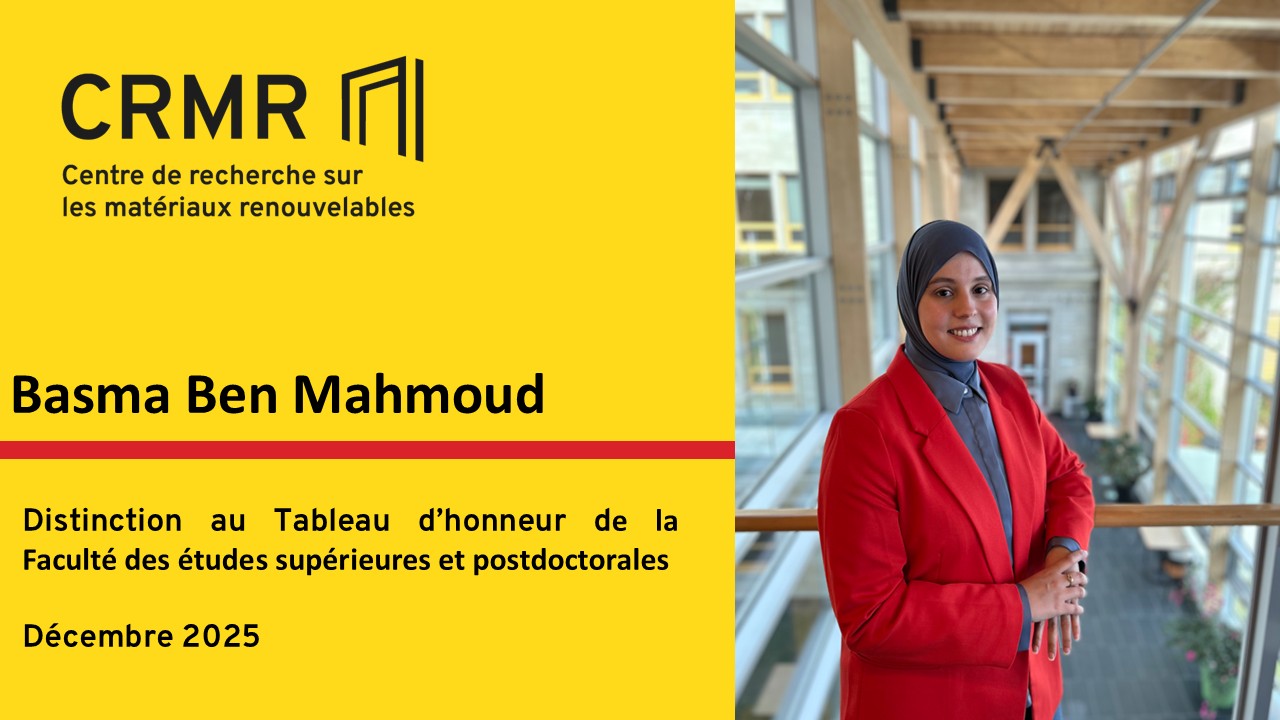
Congratulations to Basma Ben Mahmoud for her distinction on the Faculty of Graduate and Postdoctoral Studies Honour Roll for the year 2025!
We are pleased to announce that Basma Ben Mahmoud has been included on the Dean’s Honour Roll of the Faculty of Graduate and Postdoctoral Studies for the year 2025, in recognition of the excellence of her graduate-level academic performance.
A PhD candidate in Mechanical Engineering, Basma distinguished herself through exceptional academic results, unanimously praised by her thesis committee. Her dissertation, entitled « Development of Decision-Support Tools to Improve the Construction Value Chain: From Supplier Integration to Contextual Selection of Project Delivery Methods », crowns an academic path marked by scientific rigor, passion, and sustained commitment. This research was conducted under the supervision of Professor Nadia Lehoux (Laval University) and co-supervision of Professors Pierre Blanchet (Laval University) and Gabriel Jobidon (ÉTS Montréal).
Recognized for its innovative nature and strong transformative potential, this project proposes decision-support tools aimed at optimizing the construction value chain, from supplier integration to the selection of the most appropriate project delivery methods for each context.
This distinction highlights not only the exceptional quality of her research work, but also her perseverance, dedication, and passion throughout her doctoral studies.
We extend our sincere congratulations to Basma for this remarkable achievement and for the excellence of her academic journey. Her path, marked by rigor and determination, embodies academic excellence and serves as a true source of inspiration for her peers and for the next generation of researchers.
Read the thesis: Développement d’outils d’aide à la décision pour améliorer la chaîne de valeur de la construction : de l’intégration des fournisseurs au choix contextuel des modes de réalisation
Summary
In the face of an unstable and unpredictable global context, the construction value chain is proving increasingly vulnerable. Already known for its fragmentation, discontinuity, and the decentralization of decision-making among its numerous stakeholders, this chain suffers from a lack of efficiency and coordination. All these factors make the construction sector—although a key socio-economic indicator for many countries—less productive and more sensitive to external risks. Consequently, researchers and professionals are actively seeking innovative approaches to make the value chain more efficient, connected, and resilient. Among the main challenges identified are the lack of supplier integration—despite suppliers being market experts—the need for a rigorous selection of project delivery methods, which define stakeholder responsibilities and influence the adoption of more collaborative and innovative approaches, as well as the neglect of external environmental factors in decision-making processes.
It is in this context that this doctoral project aims to develop organizational and planning tools to improve the efficiency of the construction value chain. Three objectives were defined to achieve this vision. The first objective, designed to develop a theoretical framework illustrating the key mechanisms that foster supplier integration in the value chain, was achieved through a systematic literature review. Focusing on both the construction industry and more advanced sectors, this analysis identified six integration drivers. One of them, related to contractual policies, forms the foundation of the second objective. The second phase of the thesis thus focused on developing a decision-support tool based on a multi-objective optimization model that combines the assignment of project delivery methods with project scheduling, while considering internal human resource capacities. This phase relied on data collected through a literature review and collaboration with a major public client in Quebec. The developed tool demonstrated flexibility and efficiency, enabling its application in similar industrial contexts.
The final objective of this project emphasized external environmental criteria such as political and economic constraints. A second optimization model was developed to analyze the impact of these criteria on the choice of delivery methods. The first stage included only internal criteria specific to the project and the client, while the second also incorporated external factors. Sensitivity tests and scenario analyses demonstrated the significant impact of these criteria on delivery method selection, risk anticipation, and alignment with governmental directions. A complementary phase further enhanced the approach by assessing the impact of external environmental factors on both delivery method selection and scheduling, while testing certain risk mitigation measures.
This doctoral project thus provides both theoretical and practical contributions to the field of construction value chain management, highlighting concrete levers to promote early supplier integration and offering public decision-makers flexible and adaptable decision-support tools to guide the selection of project delivery methods more effectively, taking external conditions into account.