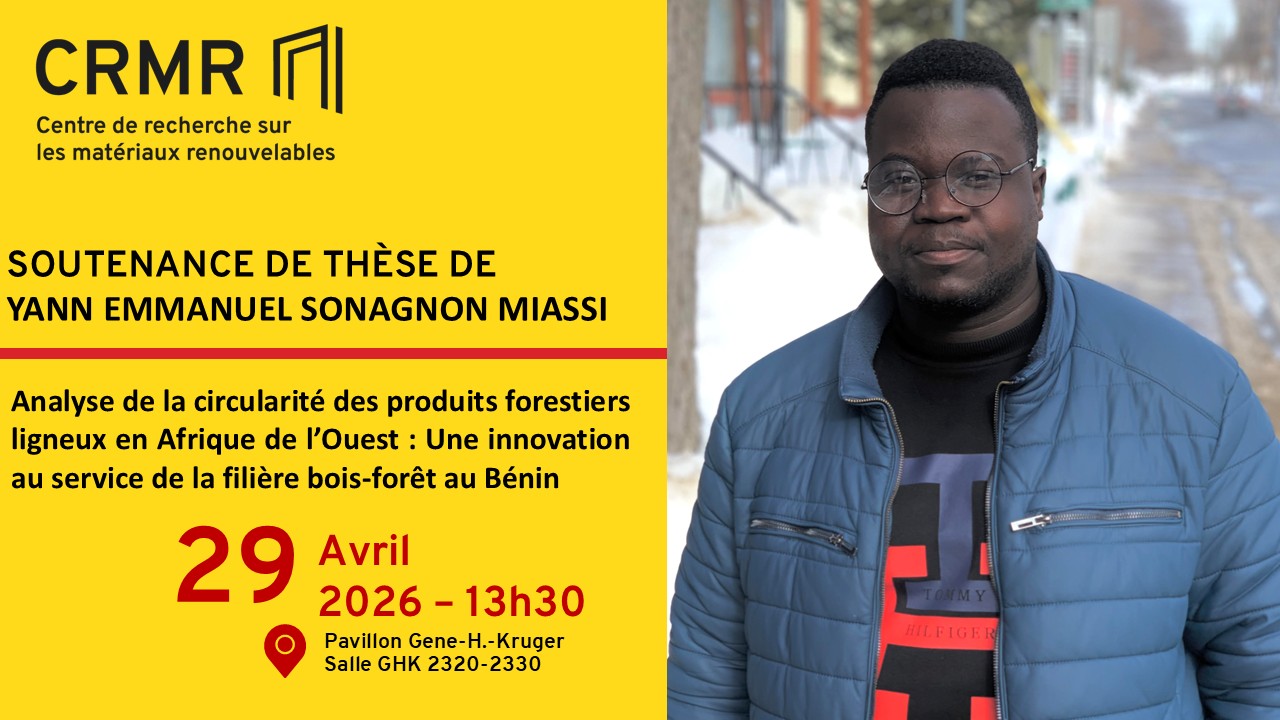
You are cordially invited to the doctoral thesis defense of Yann Emmanuel Sonagnon Miassi in Forest Sciences. The defense will take place in a hybrid format on Wednesday, April 29, 2026, at 1:30 p.m., rooms 2320–2330-GHK.
For those who wish to attend online, here is the connection link:
https://ulaval.zoom.us/j/61775307702?pwd=QMGBlfWzMLh9o5y12nUBBdfCAWg4YO.1
Wednesday, April 29, at 1:30 p.m.
Gene-H.-Kruger Building
Rooms 2320–2330 (defense)
Laval University
Jury members:
- Chair: Marie-Hélène Vandersmissen, Faculty of Forestry, Geography and Geomatics, Laval University
- Research supervisor: Nancy Gélinas, Faculty of Forestry, Geography and Geomatics, Laval University
- Internal examiner (UL): Bertrand Laratte, Faculty of Forestry, Geography and Geomatics, Laval University
- Internal examiner (UL): Bocar Samba Ba, Faculty of Agricultural and Food Sciences, Laval University
- External examiner: Adanhounme Armel Brice, Department of Human Resource Management, Université du Québec à Trois-Rivières
Title: Analysis of the circularity of wood forest products in West Africa: An innovation serving the wood-forest sector in Benin
Abstract: In a context of forest resource degradation and ecological urgency, this study examines the integration of the circular economy in the wood-forest sector in Benin. It is based on an approach combining a literature review, field surveys with stakeholders, and statistical analyses.
The results show that circularity goes beyond simple recycling to include the valorization of residues, eco-design, operational optimization, and collaborative practices such as lending and exchange. Despite growing awareness, these practices remain underdeveloped and often informal.
The adoption of circular strategies depends on key factors such as access to information, training, professional experience, partnerships, and the socio-economic profile of stakeholders. Significant regional disparities also influence adoption dynamics.
Although these strategies are perceived as beneficial environmentally, economically, and socially, their implementation is hindered by technical, financial, and institutional constraints, particularly the lack of infrastructure, the complexity of processes, and insufficient regulatory frameworks.
Thus, the transition toward an effective circular economy requires increased investment in training, innovation, incentive public policies, and partnerships in order to strengthen the sustainability of the wood-forest sector.