
Thesis Defence Announcement -Antoine Harel, PhD Candidate in Forest Sciences
You are cordially invited to attend the thesis defence of Antoine Harel, PhD candidate in Forest Sciences, held in a hybrid format on Friday, October 30, 2026, from 9:00 a.m. to 12:00 p.m.
Online Participation
Those wishing to attend the defence remotely may join via Zoom: https://ulaval.zoom.us/j/68400196538?pwd=XntU4frofF9hV0MF8B4hYthZl0vbaO.1.
Defence Information
Date: Friday, October 30, 2026
Time: 9:00 a.m. to 12:00 p.m.
Location: Abitibi-Price Building, Université Laval, Québec City
Defence: Room 1160 (ABP-1160)
Deliberation: Room 1128 (ABP-1128)
Examination Committee
Chair: André Desrochers, Faculty of Forestry, Geography and Geomatics, UL
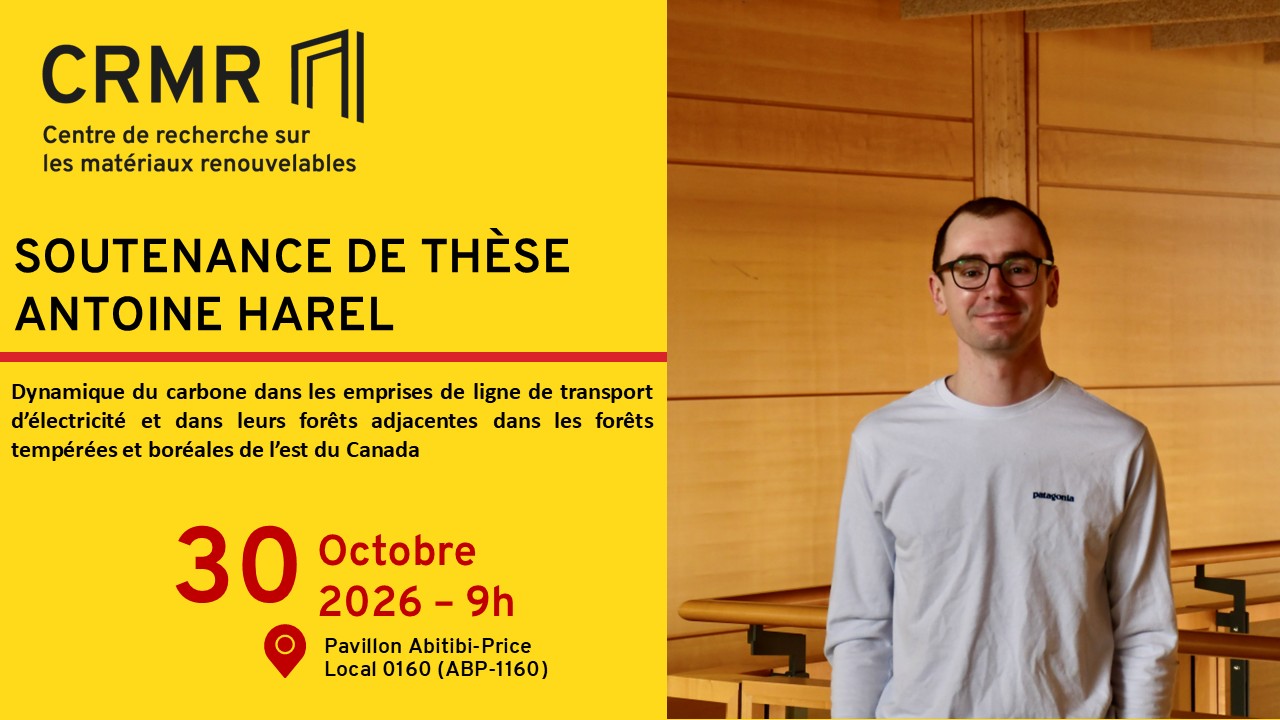
Thesis Title: Carbon Dynamics in Electricity Transmission Line Rights-of-Way and Adjacent Forests Across Temperate and Boreal Forests of Eastern Canada
Abstract:
Efforts to decarbonize electricity systems rely on major investments in new electricity transmission infrastructure. In Québec (Canada), forests are crossed by approximately 35,000 km of electricity transmission lines. The establishment of a transmission line, consisting of a cleared corridor extending 20 to 100 metres on either side of transmission towers (i.e., the right-of-way) and characterized by shrub and herbaceous vegetation, is considered a form of land-use change. As a linear anthropogenic disturbance within forested landscapes, a right-of-way may also influence vegetation dynamics and biotic or abiotic factors in adjacent forests through a forest edge effect. The overall objective of this thesis is to determine how electricity transmission lines influence carbon stocks and carbon dynamics in temperate and boreal forest ecosystems of Eastern Canada.
The first chapter examined the forest edge effect and its impact on aboveground tree biomass. Compared with interior forests, aboveground carbon stocks in edge forests were up to 60 to 75% higher in boreal spruce stands and 30% higher in temperate maple forests. No differences were observed in boreal fir forests. Higher carbon stocks were associated with greater stand density and therefore greater basal area, rather than with larger tree diameters.
The second chapter focused on soil CO₂ and CH₄ fluxes. Overall, annual cumulative soil CO₂ fluxes were lower (−7.57%) in rights-of-way and higher (+11.20%) in edge forests compared with interior forests. However, these patterns were not consistent across the bioclimatic gradient. Soil CH₄ fluxes were similar in rights-of-way, adjacent forests, and interior forests.
The third chapter linked carbon stocks and carbon fluxes by examining the relationship between soil respiration and soil temperature. In rights-of-way, higher soil temperatures were not associated with increased soil respiration rates. In contrast, edge forests exhibited higher soil respiration rates that were not correlated with changes in soil temperature. These findings highlight the importance of ecosystem productivity in regulating soil respiration through aboveground and belowground carbon inputs.
Overall, this thesis demonstrates that carbon stocks and fluxes in transmission line rights-of-way and adjacent forests differ from those observed in interior forests. The results presented here represent a first step toward a more accurate quantification of the biogenic carbon footprint of electricity transmission lines in Québec. More broadly, these findings improve our understanding of how forest edges, which may become increasingly common due to both anthropogenic and natural disturbances, influence the carbon cycle.