
Congratulations to Laurence Boudreault on the outstanding and successful defense of her doctoral thesis!
Congratulations to Laurence Boudreault, who successfully defended her PhD in Forest Sciences on December 3, 2025!
Her thesis, titled « Maalhakws (Black Ash) at the Heart of Ndakina: Cultural, Ecological, and Forestry Perspectives in a W8banaki Context for the Future of an Endangered Species », examines the challenges and perspectives related to the future of black ash and basketry in the W8banaki context, with the primary goal of supporting the Nation in its adaptation process in response to this crisis.
Through an interdisciplinary approach combining anthropology, wood analysis, and ecology, Laurence studied the relationship of the W8banakiak with black ash and its role in sustainable management, the wood properties that make the species irreplaceable for basketry, and the growth conditions that produce high-quality wood.
This achievement crowns a research project carried out with remarkable consistency and deep commitment, under the supervision of Professors Alexis Achim and Maude Flamand-Hubert (Université Laval)
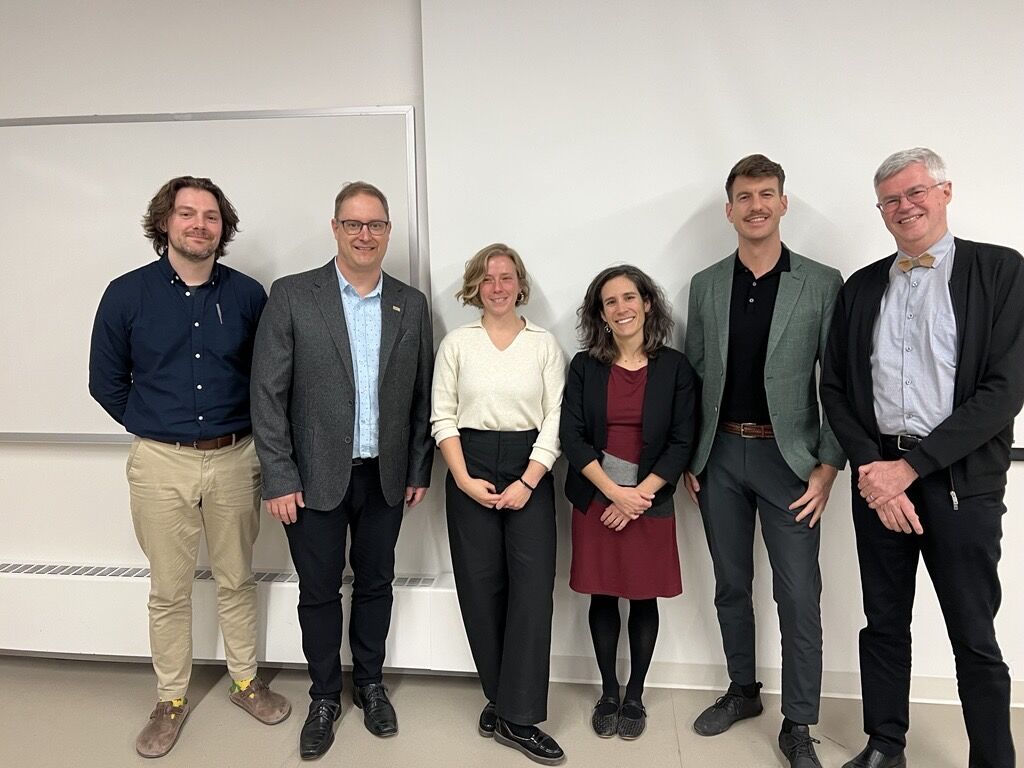
The jury, composed of renowned experts: Éric R. Labelle, Alexis Achim, Maude Flamand-Hubert, Alexandre Morin-Bernard, Olivier Villemaire-Côté (Université Laval), and Stephen Wyatt (Edmundston campus), unanimously highlighted the rigor, originality, and impact of Laurence’s work.
Congratulations, Laurence! This milestone marks a decisive step in an academic journey already rich in significant contributions and inspiring achievements.
Once again, congratulations!
Abstract
The black ash (Fraxinus nigra), or maalhakws in the W8banaki language, holds a central place in W8banakiak knowledge, identity, and daily life, particularly through basketry. This practice is grounded in a deep relationship with the land and the tree itself, which is regarded not merely as a raw material but as a living being carrying a shared history. Today, this species is severely threatened by the emerald ash borer (Agrilus planipennis), an invasive insect that causes rapid declines in ash populations across North America.
This thesis examines the challenges and prospects for the future of black ash and basketry within the W8banaki context, with the overarching goal of supporting the Nation in its adaptation to this crisis. Using an interdisciplinary approach at the intersection of anthropology, wood analysis, and ecology, it explores: (1) the relationship W8banakiak maintain with black ash and its role in stewardship; (2) the wood properties that make the species irreplaceable for basketry; and (3) the growth conditions that promote high-quality wood.
By integrating these dimensions, the thesis proposes pathways for forest management that are both culturally meaningful and ecologically appropriate, contributing to the revitalization of black ash, the transmission of traditional knowledge, and the territorial self-determination of the W8banakiak.