
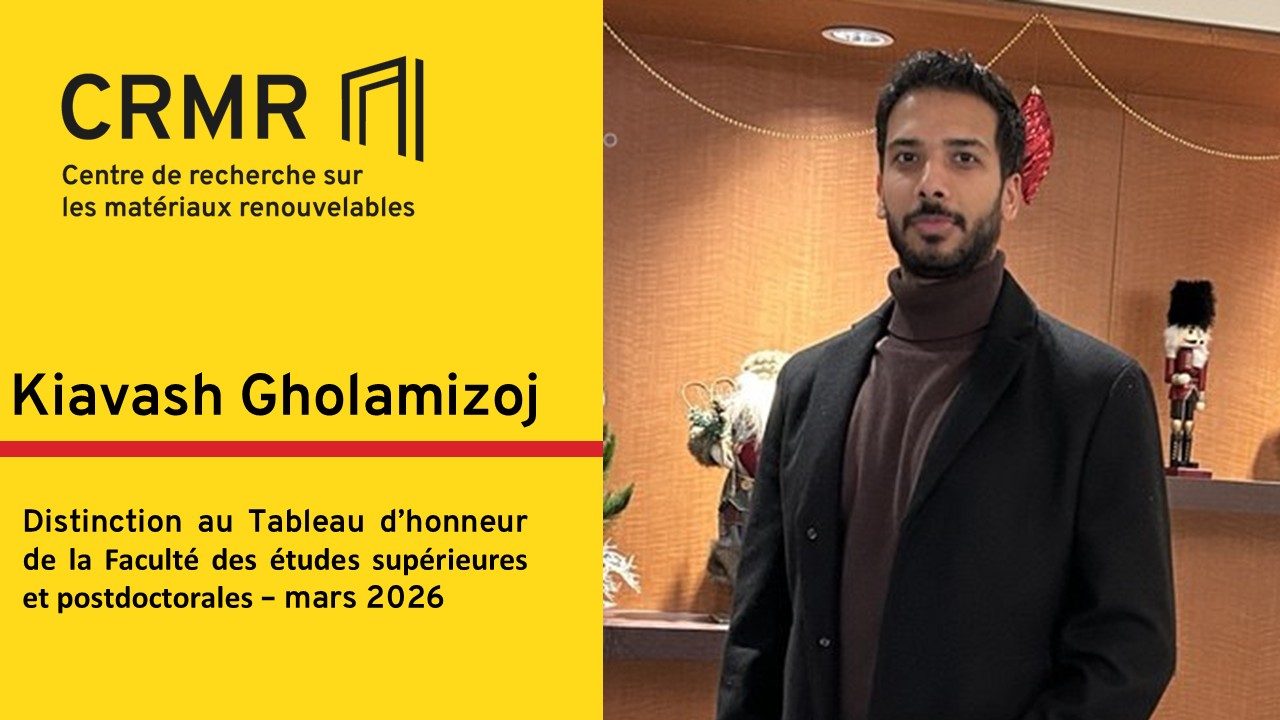
Congratulations to Kiavash Gholamizoj on being named to the Dean’s Honour Roll – March 2026!
We are delighted to announce that Kiavash Gholamizoj has been honoured with inclusion on the Dean’s Honour Roll of the Faculty of Graduate and Postdoctoral Studies for March 2026, in recognition of his academic excellence and outstanding achievements at the graduate level.
A Ph.D. candidate in wood and bio-based engineering materials, Kiavash distinguished himself through remarkable academic results, unanimously validated by his thesis committee. His research, entitled « Experimental and Numerical Study of the Seismic Behavior of Braced Timber Frame Systems », combines experimental rigour and numerical expertise to deepen understanding of the seismic performance of timber structures.
This project was conducted under the supervision of Professor Alexander Salenikovich (Université Laval), in collaboration with Professor Ying Hei Chui (University of Alberta) and Professor Peyman Homami (Kharazmi University), demonstrating his ability to excel in an international and multidisciplinary research environment.
This distinction highlights not only the excellence of his research work but also his dedication, perseverance, and passion throughout his doctoral studies.
Congratulations, Kiavash, on this exceptional achievement and your exemplary academic results! Your journey perfectly embodies academic excellence and inspires your peers, as well as the next generation of researchers, to pursue their ambitions with rigor and determination.
Thesis abstract : The increasing use of mass timber construction has highlighted the need for reliable seismic force–resisting systems. This research investigates the seismic performance of dowel-type connections with slotted-in steel plates through an extensive experimental program and develops calibrated constitutive models for nonlinear time-history analyses of multi-story timber braced-frame building archetypes. Fragility analyses and system-level simulations confirm the effectiveness of these systems and indicate that current code-prescribed force modification factors are generally appropriate for the configurations studied. To address performance objectives beyond conventional life-safety criteria, including serviceability and damage limitation, an innovative chevron-braced timber frame system incorporating elastomeric dampers was developed and evaluated using shake-table testing. The results demonstrate that the combined bracing and damping system significantly reduces seismic demands and peak floor accelerations, while influencing drift distribution, highlighting the importance of appropriate structural detailing. Overall, the research shows that, when combined with proper connection detailing, capacity design principles, and targeted damping strategies, timber braced frames constitute a robust and resilient seismic force–resisting system for mid- to high-rise mass timber buildings. The findings support ongoing refinement of seismic design provisions and promote the broader adoption of hybrid, low-damage timber structural systems.