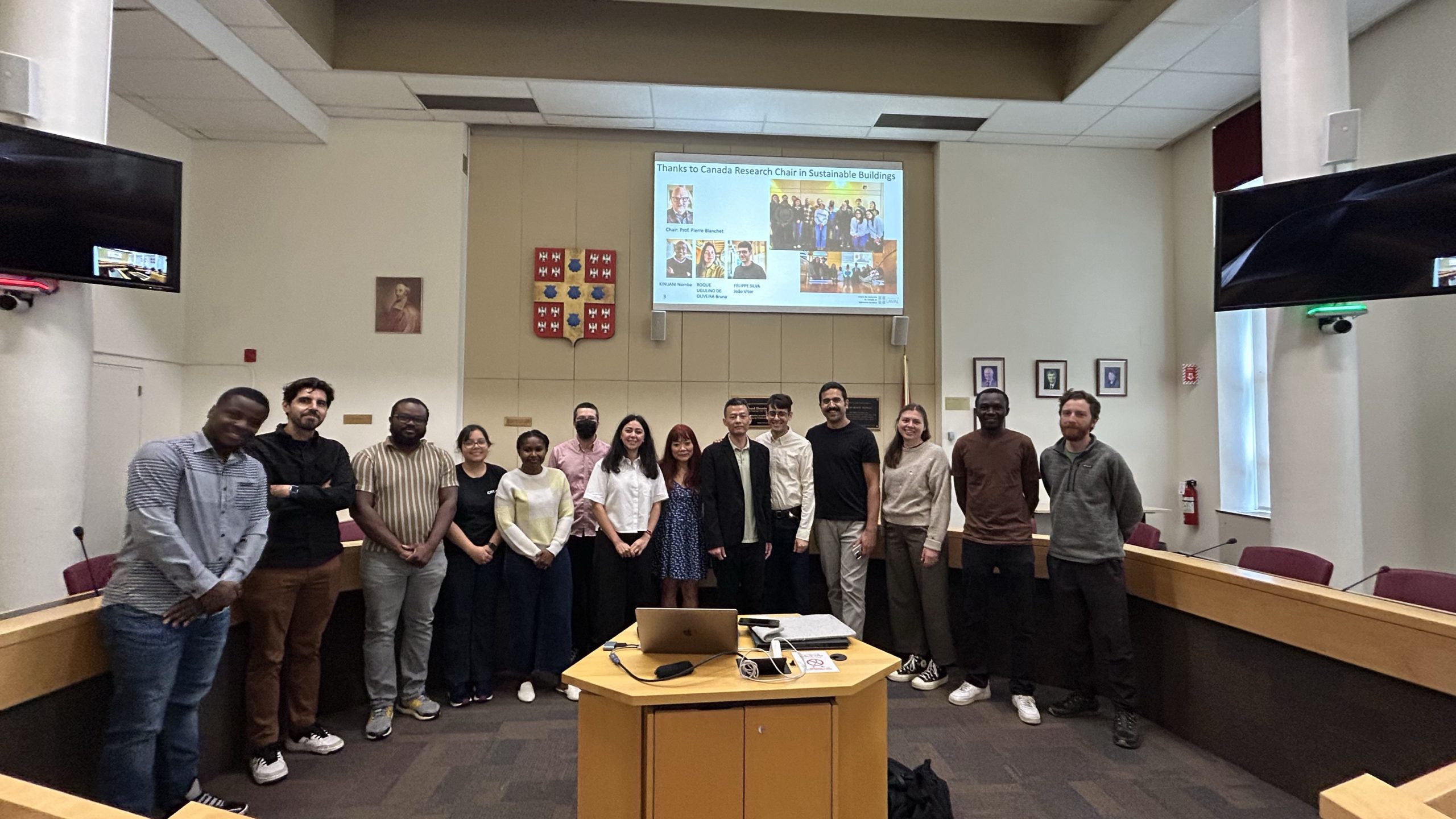
Congratulations to Bin Li on his successful doctoral thesis defense!
Congratulations to Bin Li, who successfully defended his doctoral thesis in Wood and Bio-based Engineering Materials on August 25, 2026!
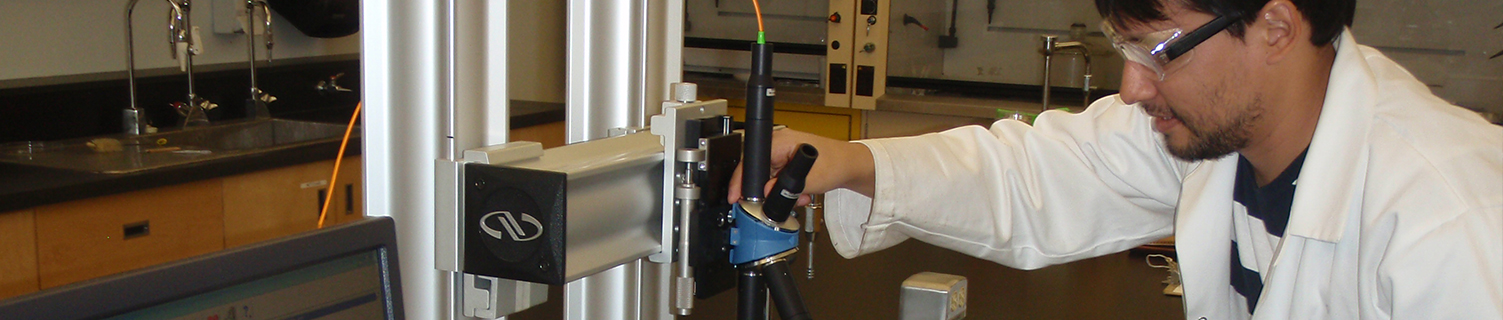
 Entitled « Characterization and Modeling of Wood Building Envelope Performance with Biobased Phase Change Materials (PCMs) », this thesis focuses on integrating bio-based PCMs into wood-frame wall assemblies to improve the energy performance and thermal comfort of residential buildings in Canada. Using numerical simulations and experimental testing, the study evaluates various PCM parameters and their effectiveness under different climatic conditions. The results show that these materials can increase the thermal inertia of walls, reduce energy requirements, and improve thermal comfort.
This achievement marks the culmination of rigorous and in-depth research conducted under the supervision of Professor Pierre Blanchet (Université Laval).
We would also like to sincerely thank the members of the examination committee for their expertise and valuable contributions: Véronic Landry (Chair), Alain Cloutier (Examiner, UL), Bertrand Laratte (Examiner, UL), Louis Gosselin (Examiner, UL), and Franz Segovia (SEREX).
Congratulations, Bin Li, on this important milestone in your academic journey! We wish you every success in your future career, in recognition of your dedication, perseverance, and excellence!
Title: Characterization and Modeling of Wood Building Envelope Performance with Biobased Phase Change Materials (PCMs)
Summary : The wood-frame building typology is prevalent in North American residential construction. As a lightweight structure system, it offers a low embodied environmental footprint and facilitates efficient construction. However, the inherently low thermal mass of wood poses a constraint on both building energy efficiency and indoor thermal comfort. In this context, novel strategies are required to reduce building energy consumption while maintaining indoor thermal comfort. A thermal energy storage (TES) system utilizing phase change materials (PCMs) addresses energy intermittency and is extensively employed in buildings to enhance thermal comfort, provide thermal protection, and achieve energy savings. However, the gap remains in innovative building envelope design incorporating PCMs, particularly biobased PCMs, for high-insulated wood-frame building envelopes under cold-climate conditions. The overall goal of this project is to contribute to knowledge on the use of PCMs and support the reduction of energy consumption and the improvement of thermal comfort in living spaces in Canada.
Firstly, a numerical simulation was carried out to assess the effects of different factors (PCMs melting point, surface area, thickness, and location) by adding a PCMs layer to building wall assemblies to reduce annual heating and cooling loads. Then, a full-scale experimental study that focused on the effectiveness of PCMs in different wall thermal resistances under various climates was conducted using a climate chamber. Finally, the thermal load and thermal comfort of residential buildings containing PCMs in three Canadian cities (Quebec City, Toronto, and Vancouver), which represent three different climate regions, were evaluated through a numerical study.
The effectiveness of PCMs in building applications depends not only on PCMs properties but also on integration techniques. The results of the thesis highlight that the PCMs layer increases the thermal inertia of the wood-frame building envelope and improves the energy management of a building under cold climate conditions. This thesis also developed strategies to enhance the integrity and thermal performance of wood-frame building envelopes by using macro-encapsulated biobased PCMs in building applications.