
A resounding success for the Annual Symposium of the Renewable Materials Research Center!
Under the theme « Sustainable Innovation in the Face of Climate Challenges », the Annual Symposium of the Renewable Materials Research Center (CRMR) took place on October 22–23, 2025, at Université Laval, bringing together nearly 90 participants, including researchers and specialists from diverse backgrounds.
Over the course of two days, discussions focused on scientific advances, technological innovations, and sustainable practices, highlighting concrete solutions to address current climate challenges. The event provided a unique platform fostering interdisciplinary collaboration, the development of greener materials, and the adoption of environmentally friendly processes. The symposium thus reinforced CRMR’s central role as a driver of innovation and strategic thinking in response to the climate emergency, while strengthening partnerships with renowned institutions such as the University of British Columbia, Université Laval, and the Ministry of Natural Resources and Forests.
Nancy Gélinas, Dean of the Faculty of Forestry, Geography, and Geomatics, delivered the opening address, expressing her deep gratitude to all participants, speakers, and panellists for their commitment. She emphasized the importance of bringing together CRMR members and experts from diverse fields to promote dialogue, stimulate collaboration, and encourage sustainable innovation in the face of climate challenges, particularly through the development of environmentally responsible materials.
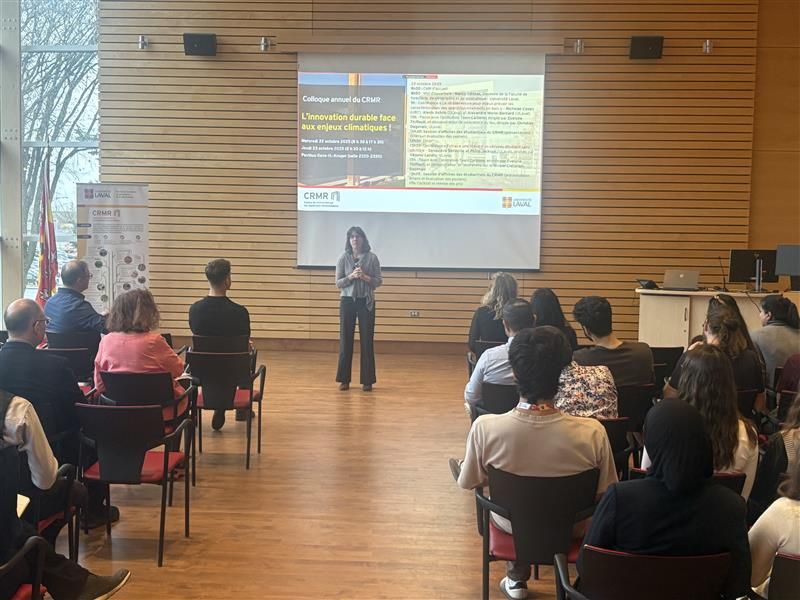
Opening of the conference by Nancy Gélinas
The program featured a poster session highlighting student projects, lectures on a wide range of topics related to renewable materials, interactive kiosks on plant identification, an industrial demonstration from the fire laboratory, and a multidisciplinary roundtable designed to exchange perspectives and identify concrete courses of action.
In collaboration with Professors Alexandre Morin-Bernard and Alexis Achim, the first lecture, delivered by Professor Nicholas Coops on « Remote Sensing for Better Forecasting of Timber Supply Characteristics », made a significant contribution to research. It showcased cutting-edge expertise in forest remote sensing, linking fundamental research with practical applications, particularly in timber supply forecasting and climate change adaptation. The lecture also promoted collaborative projects integrating satellite imagery, LiDAR, and dendrochronology to support the sustainable management of Québec’s forests.
Nicholas Coops, Canada Research Chair in Remote Sensing at the University of British Columbia, is internationally recognized for his work on ecosystem analysis using satellite imagery and airborne laser scanning (ALS). Alexis Achim, Scientific Director of Montmorency Forest and NSERC Chair in Climate-Adaptive Silviculture, focuses on adapting silvicultural practices and valorizing wood fibers for sustainable materials. Alexandre Morin-Bernard specializes in forest ecosystem remote sensing, combining satellite imagery, LiDAR, and dendrochronology to analyze forest growth and resilience in response to climate disturbances, and developing multi-scale approaches to predict forest evolution.
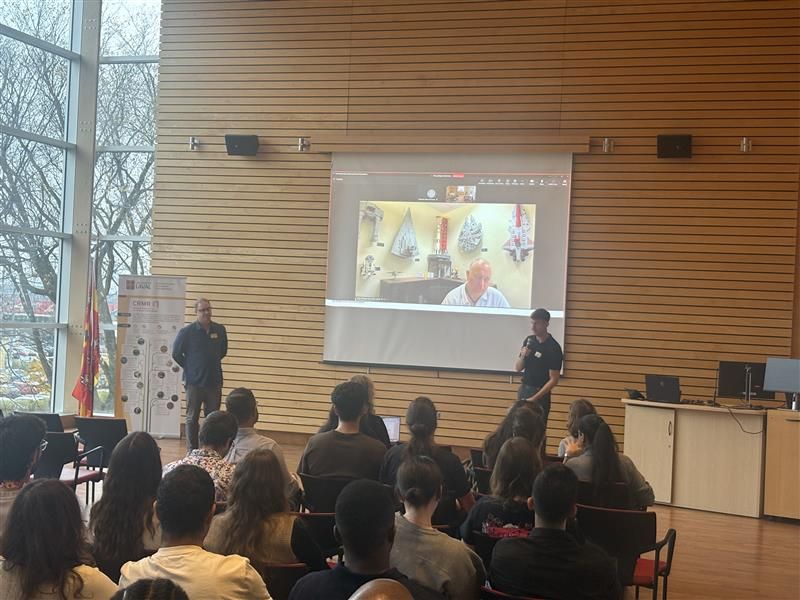
From left to right: Alexis Achim, Nicholas Coops, and Alexandre Morin-Bernard
After a break led by Team Carbone focused on plants, directed by Evelyne Thiffault’s team, and a fire-test demonstration conducted by Professor Christian Dagenais’s team (Luc Girompaire and Antony Beaulieu), the conference continued with the poster session at the CRMR. We thank them for the excellent facilitation and the careful organization of this workshop, which greatly enriched the session.
Forty students presented their work on a wide range of topics, from sustainable materials and technologies to industrial applications, providing a glimpse into the innovative projects of the next generation of scientists. They successfully made their research accessible to a diverse audience, demonstrating both their expertise and their ability to communicate innovative solutions. These presentations helped highlight scientific advancements and raise awareness of environmental issues. The session also encouraged dialogue among professors, researchers, professionals, and industry stakeholders, while allowing the panel to evaluate the excellence and originality of the presentations. This exchange underscored the essential role of the symposium in promoting research, innovation, and interdisciplinary networking.
Thanks to the support of the CRMR, four awards were presented to student participants, recognizing the excellence of their scientific posters!
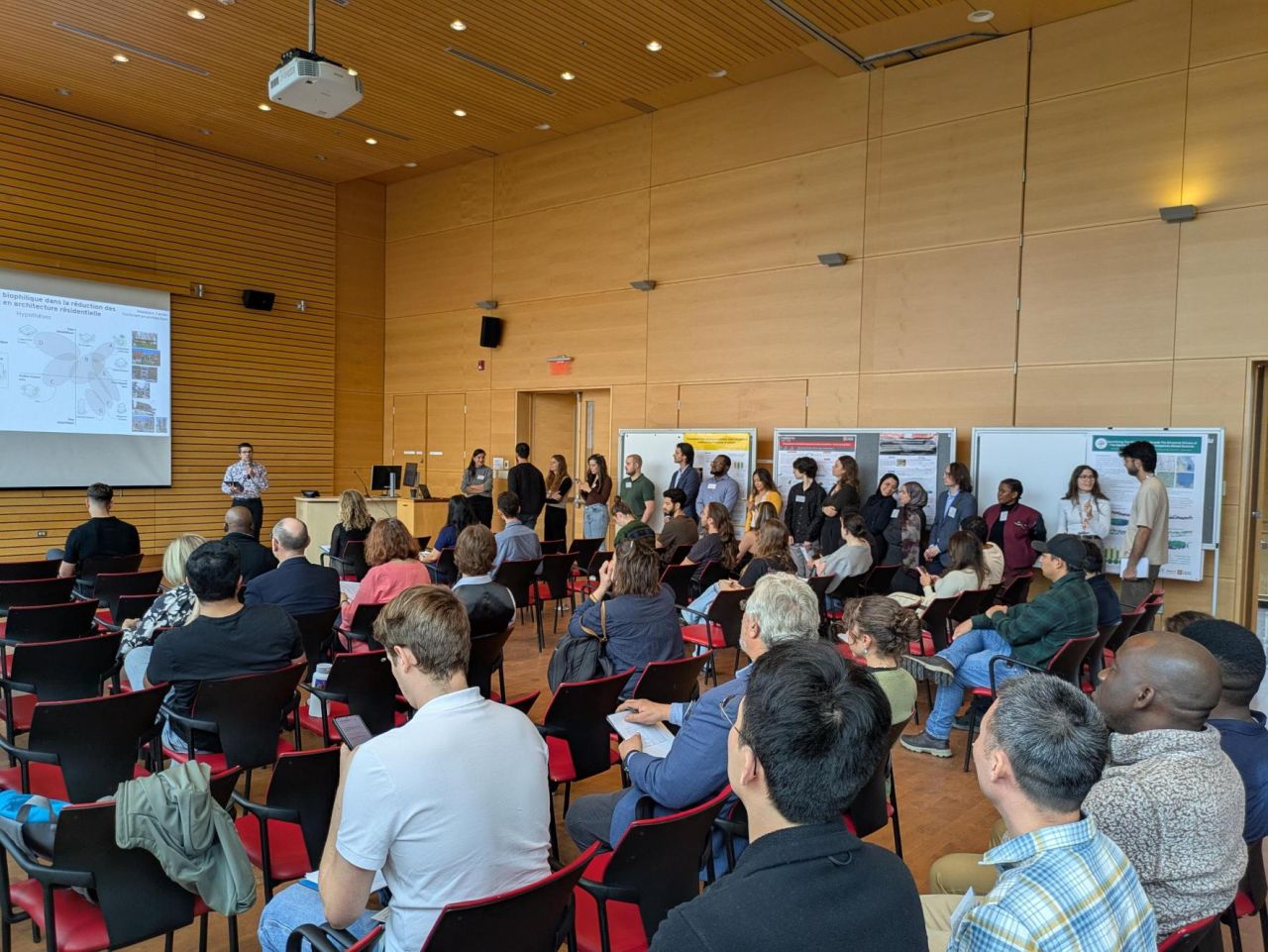
Lightning session of posters by female and male students
After lunch, the day was further enriched by the symposium’s second lecture, « Extracting a Thesis from a Student’s Brain Without Waste,» organized by Professor Véronic Landry. Led by Geneviève Belleville and Philip L. Jackson, professors at the School of Psychology at Université Laval, this presentation draws on their book published in 2025 and offers practical approaches to support graduate students in writing their theses. Geneviève Belleville, a specialist in anxiety and post-traumatic stress, also studies inclusivity in online interventions, an expertise that allows her to address the challenges of stress and procrastination associated with thesis writing with nuance. Philip L. Jackson, an expert in human empathy and its neural markers, leverages his understanding of empathic mechanisms to promote supportive and constructive supervision.
During the conference, the two speakers presented practical strategies to support student perseverance, optimize supervision, and foster a kind and motivating mentoring environment. They emphasized the importance of harmonious collaboration between students and supervisors, effective stress management, and structured work organization, while reminding participants that academic challenges can be transformed into learning opportunities. The session featured constructive exchanges and enriching discussions, allowing participants to ask questions, share experiences, and collectively reflect on best practices to support graduate student success.

Geneviève Belleville
After a second period of rich exchanges during the student poster session, the day concluded in a warm and convivial atmosphere with a cocktail reception. This event allowed participants to continue discussions informally, build connections, and exchange ideas in a relaxed setting, thereby fostering networking and interdisciplinary collaboration.
The award ceremony was a highlight of the day, recognizing the excellence and creativity of the students’ work. Congratulations to the student award winners:
🥇Ilias El Ouahabi – Best Student Scientific Poster ($350)
🥈Lucie Dehon – Second Best Scientific Poster ($200)
🥈Félix Coulaud – Second Best Scientific Poster ($150)
💖Mariel Alejandra Zevallos Luna – People’s Choice Award ($50)
⭐João Vitor Felippe Silva – Jury’s Award
A special thanks also goes to the jury members for their commitment and time, as well as to Maxime Parot for his outstanding work in organizing and facilitating this poster session. Thanks also to Imenne Drif, Manon Mestre, Laura Chrétien, and Lucie Dehon for their valuable contributions to the session logistics.
This convivial closing allowed participants to celebrate the achievements of the students while strengthening exchanges and collaboration among researchers, professionals, and attendees, creating a promising momentum for the remainder of the symposium.
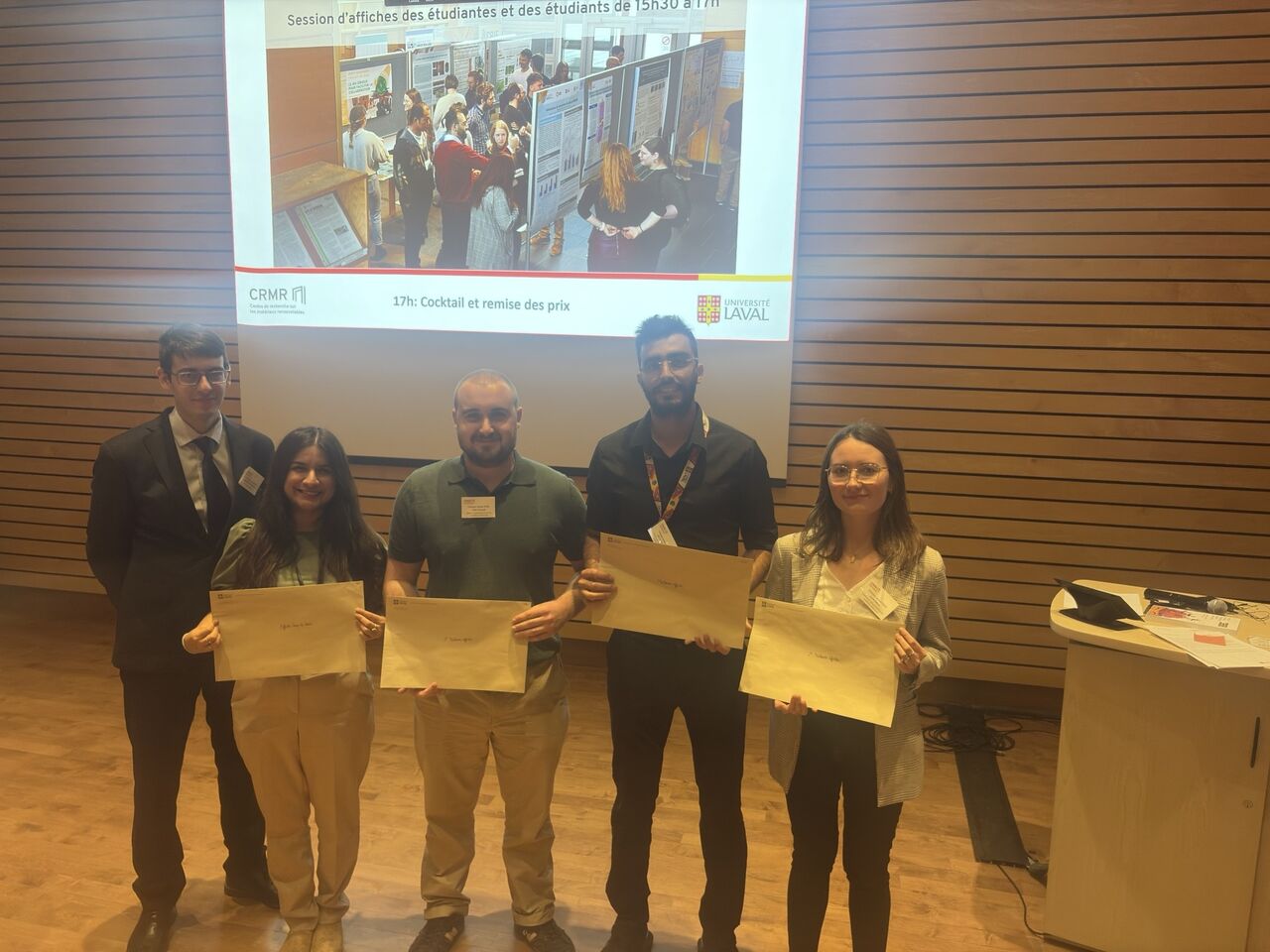
From left to right: João Vitor Felippe Silva, Mariel Alejandra Zevallos Luna, Félix Coulaud, Ilias El Ouahabi, and Lucie Dehon
The second day of the symposium continued with the third lecture, offering participants a fresh perspective on the recycling and valorization of materials. Organized by Alain Cloutier, this session highlighted the work of the Consortium de recherche sur les panneaux composites à base de bois (Corepan-Bois) under the theme: « Recycling Wood-Based Composite Panels: Challenges, Technologies, and Perspectives.»
An expert in composite panels and the principal researcher of the CorePAN-Bois consortium, Alain Cloutier explored in depth the technological advances and challenges related to the valorization of wood-based composite materials. Discussions focused on innovations that extend panel lifespan, optimize recycling, and reduce environmental impact, while also addressing the technical and economic obstacles that need to be overcome.
The invited speaker, Maxime Arsenault, a wood engineer at the ministère des Ressources naturelles et des Forêts du Québec since 2019, then presented « The Quebec Wood-Based Composite Panel Industry: Overview and Prospects ». Drawing on extensive experience in industrial production, process optimization, quality management, technical support, project management, and supervision, he provided an insightful overview of the sector’s challenges, growth opportunities, and its strategic role in the transition to a circular economy.
By bringing together researchers, professionals, and decision-makers, this session offered a comprehensive and nuanced picture of innovations, challenges, and future prospects in the wood-based composite panel sector, while fostering constructive exchanges that will support the continuation of research and development efforts.
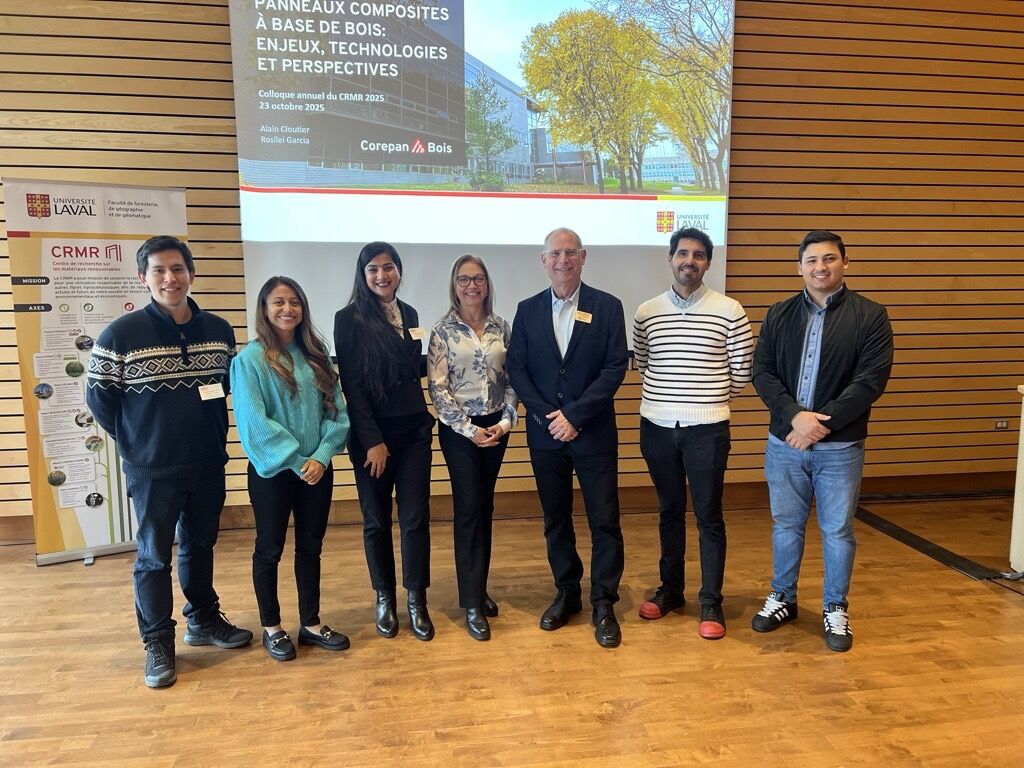
CorePAN-Wood Team
The symposium concluded with a highly engaging roundtable on « Limits and Opportunities in the Reuse of Construction Materials,» which highlighted scientific and technological advances, innovative materials, and sustainable practices transforming the construction sector. The event emphasized the central role of innovation in the transition toward a truly circular economy.
Organized and moderated by Bertrand Laratte, Associate Professor of Environmental Engineering at Université Laval and specialist in life cycle analysis, eco-design, material flows, and circular economy, the roundtable sparked rich, stimulating, and complementary discussions.
The panelists were:
-
Pierre Blanchet, Full Professor in the Department of Wood and Forest Sciences at Université Laval and Director of the graduate programs in Wood Engineering and Bio-based Materials. Holder of the Canada Research Chair in Sustainable Building, his research focuses on wood processing, sustainable construction, eco-design, and the durability of materials and buildings, contributing to innovation in responsible construction.
-
Marc Journeault, Full Professor at the School of Accounting, Faculty of Business Administration, Université Laval, and Head of the Research Center on Accounting and Sustainable Development (CerCeDD). His research covers environmental accounting, circular economy, performance management, and strategic control, and he collaborates with the Québec Network for Circular Economy Research (RQREC).
-
Zahra Hosseini, engineer and researcher at the Québec Network for Circular Economy Research (RRECQ) at ÉTS. Her thesis, supervised by Pierre Blanchet and co-supervised by Bertrand Laratte, examined wood construction from a circular economy perspective. Her current research focuses on synergies between circular economy and biodiversity.
The panelists discussed key topics, including the role of digital tools in material reuse, financial barriers faced by companies and researchers, concrete actions to promote the market integration of reused materials, and methods and tools to ensure traceability throughout a material’s lifecycle. These discussions allowed for the crossing of technical, economic, and regulatory expertise, opening concrete pathways to accelerate the adoption of circular practices in the construction sector. The roundtable highlighted the importance of collaboration among researchers, professionals, and decision-makers in building a sustainable and responsible future.
Special thanks are also extended to João Vítor Felippe Silva, Bruna Ugulino, Jeremy Piggot Navarrete, and Maxime Parot for their invaluable contribution in preparing the roundtable questions.
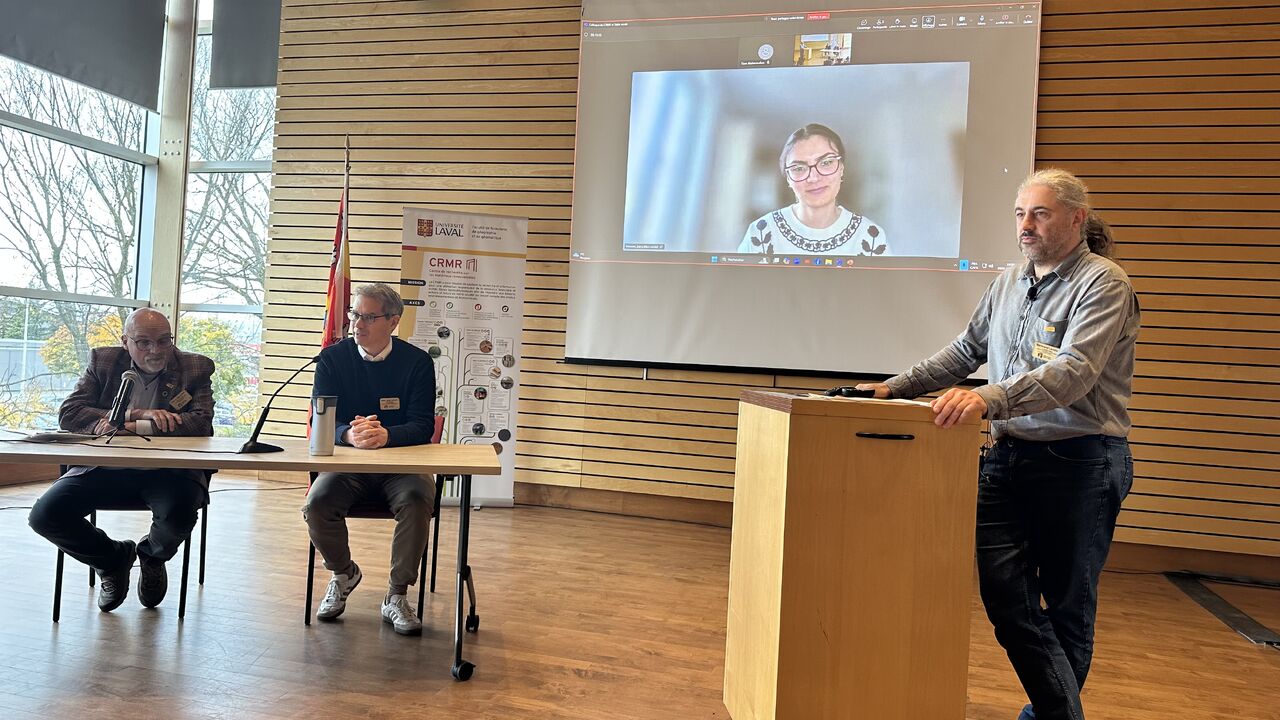
From left to right: Pierre Blanchet, Marc Journeault, Zahra Hosseini, and Bertrand Laratte
Closing Remarks and Acknowledgments
The symposium concluded on a high note with Evelyne Thiffault, Professor and Co-Director of the CRMR, who recognized the outstanding commitment of everyone who contributed to the event’s success. She offered special thanks to researchers Véronic Landry, Alain Cloutier, Bertrand Laratte, Alexis Achim, Alexandre Morin-Bernard, Pierre Blanchet, and Christian Dagenais for their pivotal roles in organizing the various sessions of the symposium. She also expressed her gratitude to the speakers, panelists, and all participants for their contributions to the stimulating exchanges and enriching discussions throughout the symposium, as well as to the organizing committee, in particular Besma Bouslimi, for their essential role in coordinating and ensuring the event’s success.

Evelyne Thiffault
Organizing Committee of the 2025 CRMR Annual Symposium
The symposium committee warmly thanks all participants for the inspiring sharing of their research and development results. The diversity of perspectives, innovative ideas, and experiences presented made this symposium a valuable experience for the scientific and professional community. The committee also expresses its sincere gratitude to the IT and technical support team—Joseph-Antoine Coté, Tiam Mahmoudian, and Kaven Després—whose involvement was essential to the smooth running of the event.
Symposium Committee Composition
Symposium Organizers: Besma Bouslimi, Evelyne Thiffault, Véronic Landry, Alain Cloutier, Bertrand Laratte, Alexis Achim, Alexandre Morin-Bernard, Pierre Blanchet, and Christian Dagenais.
Poster Session Team: Maxime Parot (session leader), Imenne Drif, Laura Chrétien, Lucie Dehon, and Manon Mestre.
IT Logistics Coordinator for Symposium Days: Tiam Mahmoudian.
Dinner Logistics and Participant Reception: Cindy Perrot and Sylvie Langevin, whose constant support significantly contributed to the comfort and smooth running of the day.
Symposium Logistical Support Team: Ilias El Ouahabi, Raissa Ngwane Tchanyo, Isabel Cristina Gomez Garcia, Sara Etminanrezaeieh, and Hossein Alinezhadavalzali.
The dedication, professionalism, and hard work of the entire committee and support teams were instrumental in the success of this event, helping to make this symposium a memorable and enriching experience for the entire scientific and professional community.