
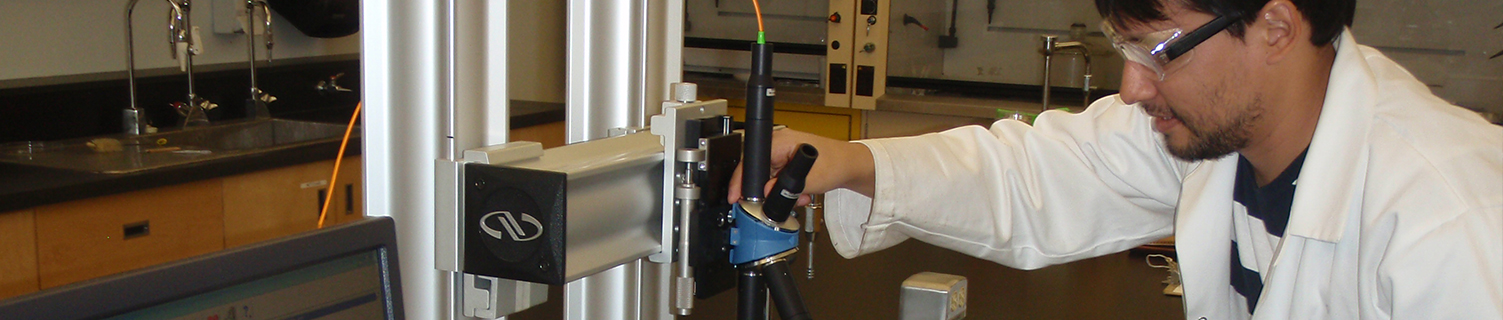
Congratulations to Lucie Dehon for receiving the prestigious ASMAC – Adhesives and Coatings scholarship!
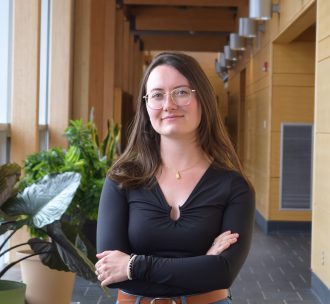 Lucie Dehon received a scholarship worth $3,000 in recognition of the excellence of her research in the field of bio-based materials.
A doctoral student in Wood and Bio-Based Materials Engineering under the supervision of Véronic Landry, Lucie is dedicated to developing formaldehyde-free bio-based adhesives from proteins derived from agri-food by-products. Her goal: to design a high-performance bio-adhesive for composite wood panels, combining efficiency with environmental sustainability.
To achieve this, she explores chemical reactions inspired by green chemistry, such as the Michael addition reaction, to improve water resistance and adhesion of her formulations to wood fibres. The resulting bio-based adhesives are then compared with conventional petrochemical adhesives to evaluate their chemical, physical, and mechanical properties. Protein and adhesive analysis methods will measure the effectiveness of the chemical reactions, while the performance of assembled panels will be tested according to ASTM standards and compared with conventional adhesives such as UF and PF used in particleboard.
The ASMAC scholarship, awarded to students whose research advances knowledge on bio-based adhesives and coatings, supports innovation and encourages the development of environmentally friendly solutions. By recognizing scientific excellence and the tangible impact of this work, it contributes to the evolution of industrial practices toward sustainable alternatives.
Congratulations to Lucie for this outstanding achievement and for her commitment to sustainable innovation!
For more information on the scholarship: ASMAC Scholarship – Adhesives and Coatings
A huge thank you to the Research Consortium on Wood-Based Composite Panels (COREPAN-Bois) for funding Lucie’s project. This support helps turn innovative ideas into sustainable solutions while fostering the advancement of technologies with a low environmental footprint.
—————————————
Research Project Summary: Development of bio-based adhesives without formaldehyde emissions from proteins derived from by-products
The wood industry is a major sector in North America, generating nearly $17 billion in Canada (2022). The production of composite panels allows for the valorization of wood waste from sawmill residues but requires high-performance, durable adhesives compatible with industrial processes. The growing demand for safer, more eco-friendly products is pushing the industry to reduce the use of petrochemical adhesives, which, despite their efficiency, release volatile organic compounds, including formaldehyde.
This project aims to develop protein-based bio-adhesives derived from agri-food by-products, with zero formaldehyde emissions, for composite wood panels. Proteins, which are sustainable, non-toxic, and low-cost, represent a promising alternative to petrochemical adhesives, although formulating them to achieve comparable performance remains a challenge.
The methodology is based on three main areas:
-
Analysis of by-products and proteins: gentle and environmentally friendly extraction, characterization of chemical, physical, and structural properties.
-
Chemical modification and adhesive formulation: activation of functional groups via aza-Michael and thiol-Michael reactions, followed by viscosity tests, gel time, shelf life, and water resistance assessments.
-
Panel assembly and evaluation: fabrication of composite panels, mechanical and physical testing according to ASTM and ANSI standards, measurement of VOC emissions, and comparison with petrochemical adhesives (UF, PF).
Expected outcomes include protein characterization, optimization of chemical reactions, and the formulation of stable, moisture-resistant bio-based adhesives. The effectiveness of these adhesives will be compared to industry standards, with a focus on durability, safety, and environmental performance.
This project will help reduce fossil fuel dependence in the wood panel sector, promote renewable alternatives, and strengthen Quebec’s position in sustainable innovation. The results will be disseminated through scientific publications and industry collaborations, enabling concrete technology transfer for the production of eco-friendly and competitive composite panels.