
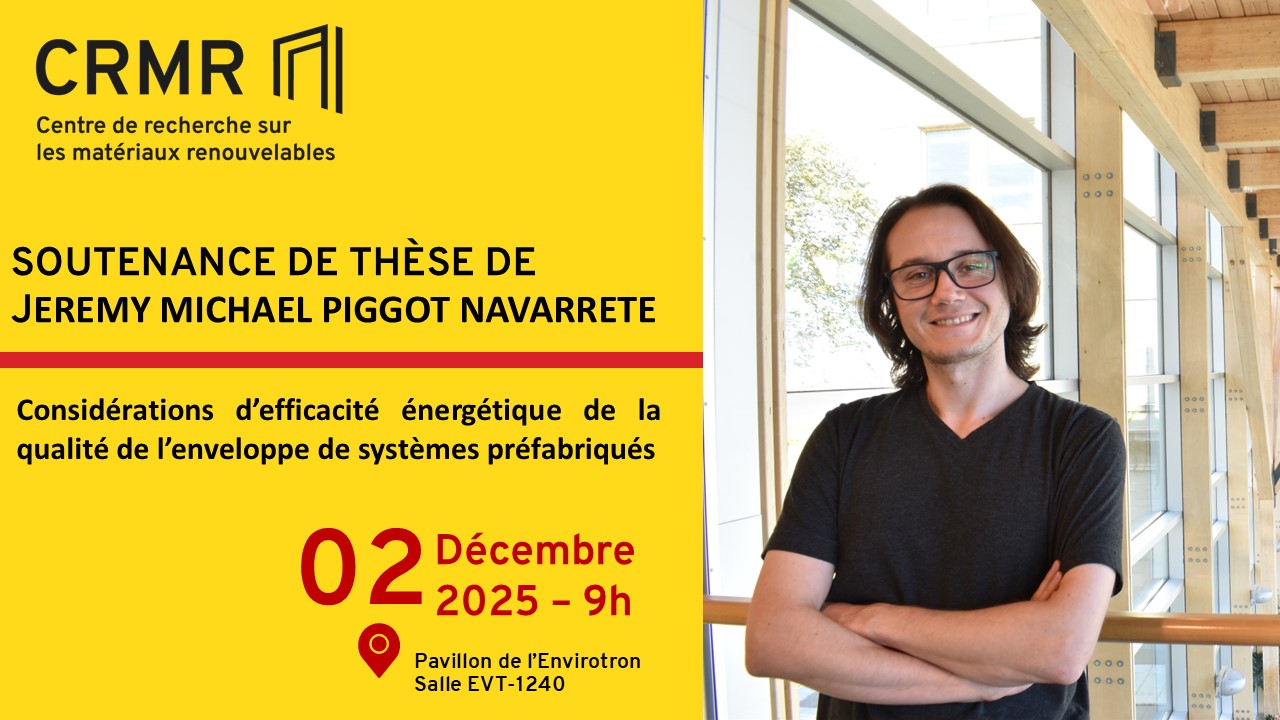
Thesis Defense Announcement of Jeremy Michael Piggot Navarrete — PhD in wood and bio-based materials engineering — December 2, 2025
You are cordially invited to attend the thesis defense of Jeremy Michael Piggot Navarrete, PhD candidate in wood and bio-based materials engineering, which will take place on Tuesday, December 2, at 9:00 AM at Université Laval.
For those wishing to attend online, here is the connection link: https://ulaval.zoom.us/j/62576081524?pwd=QcPFqxnOtRzpOlPmsZFFPVAg58fBaF.1
Envirotron Building
Room EVT-1240
2480 Boulevard Hochelaga, Québec
Université Laval
Thesis Committee Members
-
Chair: Daniel Beaudoin – Faculty of Forestry, Geography, and Geomatics, Université Laval
-
Supervisor: Pierre Blanchet – Faculty of Forestry, Geography, and Geomatics, Université Laval
-
Université Laval Examiner: Alain Cloutier – Faculty of Forestry, Geography, and Geomatics, Université Laval
-
External Examiner: Maria Beatriz Piderit Moreno – Universidad San Sebastián
-
Additional Examiner: Franz Segovia Abanto – SEREX
Title: Energy Efficiency Considerations of Prefabricated Building Envelope Quality
Abstract:
Due to climate change, reducing global energy demand is becoming increasingly necessary. The construction sector, responsible for approximately 40% of global energy consumption, must therefore explore new high-energy-efficiency technologies. In this context, the prefabrication of building envelopes is increasingly utilized, thanks to its clear advantages and improved quality control.
Prefabricated timber wall panel systems are manufactured under controlled conditions in off-site facilities. As a result, they are expected to exhibit superior thermal properties. It is assumed that timber prefabricated envelopes can significantly reduce the energy demand of buildings. However, these panels are installed on-site, where conditions differ from those in the factory, potentially causing issues at panel junctions. Moreover, the scientific literature on this topic remains limited.
The main objective of this research was to assess the improvements provided by timber prefabricated envelopes on the hygrothermal and energy performance of buildings, compared to traditional systems, under current and future climatic contexts.
The adopted methodology was structured in three complementary steps. In the first step, the hygrothermal performance and airtightness of a traditional timber envelope system were analyzed through laboratory experiments focusing on heat transfer and air infiltration. The negative influence of on-site construction defects was also quantified. The second step involved evaluating envelope systems composed of prefabricated timber panels, applying the same experimental methodology as in the first step. Finally, the third step consisted of a comparative analysis of the energy demand associated with each type of envelope system (prefabricated and traditional), conducted using dynamic building energy simulations. This analysis considered both current climatic conditions and future climate projections.
The results quantified the gains provided by using prefabricated timber panels in buildings, in terms of both hygrothermal and energy performance, and offered insights into their behavior under future climate scenarios. They also identified elements of different envelope systems requiring improvement, particularly the panel junction systems.