

SWST International Convention 2026: Innovation et durabilité au cœur de la recherche de Corepan-Bois!
Une forte présence à la SWST International Convention 2026!
Par : Besma Bouslimi
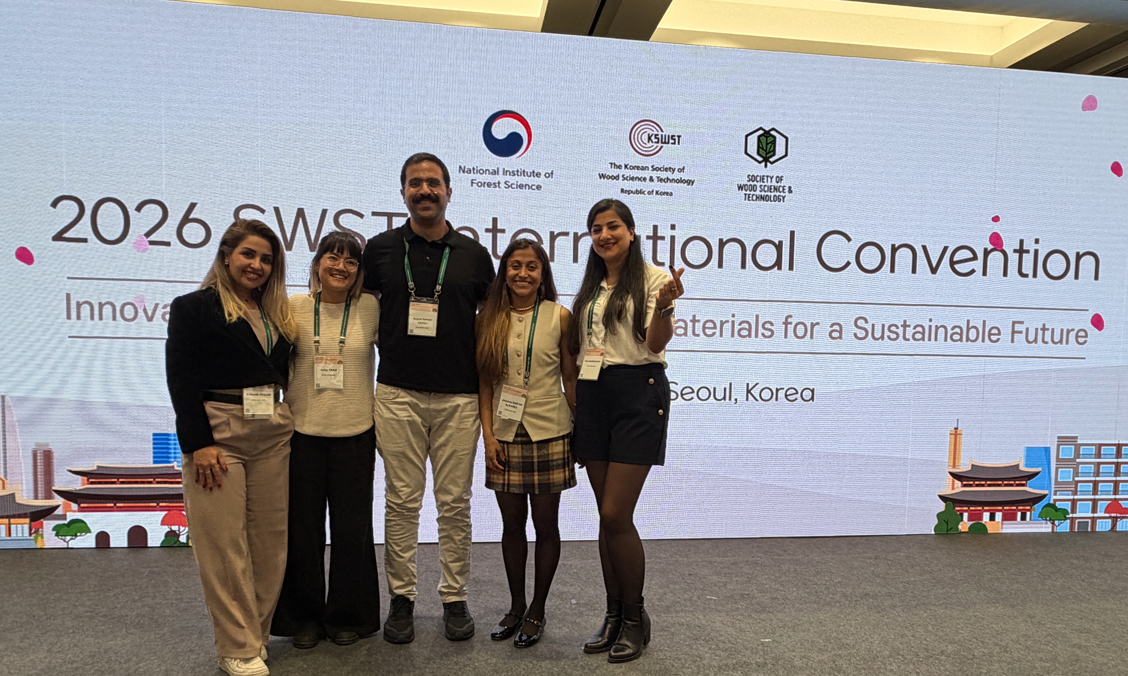
Dans le cadre de la SWST International Convention 2026, tenue à Séoul, en Corée du Sud, du 7 au 12 juin 2026, plusieurs membres de l’équipe de recherche Corepan-Bois ont présenté avec succès leurs travaux portant sur l’innovation et la durabilité des matériaux lignocellulosiques et des panneaux de bois. Cette participation témoigne à la fois du dynamisme scientifique de nos membres et de l’essor du rayonnement international de leurs travaux.
La professionnelle de recherche Vahideh Akbari a présenté, en collaboration avec le postdoctorant Anass Ait Benhamou et sous la direction de Véronic Landry, une communication intitulée : « Lignin-carbohydrate nanoparticles from low-purity lignin: a potential reinforcement for particleboard enhancement ». Ce travail explore le potentiel des nanoparticules lignine-glucides issues de lignine de faible pureté comme agents de renforcement innovants, afin d’améliorer les performances des panneaux de particules. Ces nanoparticules ont été incorporées en faible proportion dans une résine urée-formaldéhyde utilisée pour la fabrication de panneaux de bois. Les résultats montrent qu’elles améliorent les propriétés mécaniques des panneaux tout en réduisant les émissions de formaldéhyde, avec un optimum autour de 1 % d’incorporation. Malgré une légère diminution de la réactivité de la résine, le procédé reste globalement viable. Cette approche permet de transformer un déchet industriel en additif fonctionnel, améliorant à la fois la performance et l’impact environnemental des panneaux de particules.
La doctorante Tiam Mahmoudian a présenté une communication intitulée : « Dimensional stability and mechanical performance of exterior-grade particleboard and MDF after accelerated aging ». Cette étude, menée sous la direction d’Alain Cloutier et d’Aziz Laghdir, en collaboration avec Rosilei Garcia, évalue la durabilité de panneaux composites à base de bois destinés à des applications extérieures et semi-exposées, après un vieillissement accéléré selon la norme ASTM D1037. Les travaux mettent en évidence l’évolution de la performance mécanique et de la stabilité dimensionnelle des panneaux de particules et des MDF dans ces conditions de vieillissement, apportant ainsi des connaissances essentielles à la compréhension de leur comportement à long terme. Les résultats montrent clairement que la structure du panneau et le type d’adhésif jouent un rôle déterminant dans la résistance au vieillissement.
La doctorante Johanna Gaitan-Alvarez a présenté la communication intitulée : « Influence of refining parameters on fiber granulometry, surface quality, and mechanical properties of embossed MDF door panels ». Réalisée sous la direction d’Alain Cloutier et de Véronic Landry, en collaboration avec Rosilei Garcia, cette étude examine l’influence des paramètres de raffinage sur la granulométrie des fibres, la qualité de surface et les propriétés mécaniques des panneaux MDF embossés. Les résultats montrent que l’optimisation du procédé de raffinage est essentielle pour améliorer la performance des panneaux destinés aux portes embossées. La pression de vapeur et l’énergie de raffinage influencent principalement la morphologie des fibres ainsi que les propriétés mécaniques, tandis que la pression différentielle exerce un effet secondaire. L’étude souligne également que les performances mécaniques et l’adhésion varient selon les conditions de raffinage et le type d’adhésif utilisé.
Le doctorant Seyed Saman Vakili a, pour sa part, présenté une communication intitulée : « Integrated process optimization and molecular characterization of boreal bark-derived tannins for sustainable particleboard manufacturing ». Cette recherche, menée sous la direction de Véronic Landry et de Papa Niokhor Diouf, en collaboration avec Vahideh Akbari, propose une approche intégrée combinant l’optimisation des procédés d’extraction et la caractérisation moléculaire approfondie des tanins issus d’écorces boréales, dans le but de développer des solutions plus durables pour la fabrication de panneaux de particules. Les résultats montrent que les tanins extraits des écorces de conifères boréaux, en particulier des épinettes, présentent un fort potentiel comme alternative aux adhésifs pétrochimiques. L’extraction alcaline s’est révélée la plus efficace, permettant d’obtenir des tanins plus réactifs, tandis que le pin gris affiche des performances plus faibles en termes de rendement et de composition.
Bénéficiant de l’appui du programme d’aide à la mobilité étudiante du CRMR, la participation de Tiam Mahmoudian, Johanna Gaitan-Alvarez et Seyed Saman Vakili à cet événement international a constitué une occasion privilégiée de renforcer leurs compétences scientifiques et d’accroître leur visibilité académique. Elle a également mis en lumière le dynamisme de leur institution et l’impact significatif de leurs recherches dans le domaine des matériaux bois.
Dans son ensemble, cette participation illustre l’engagement soutenu de l’équipe envers le développement de solutions innovantes, performantes et respectueuses de l’environnement pour l’industrie des matériaux bois. Elle contribue également à renforcer sa visibilité et son influence à l’échelle internationale.
Résumés des communications scientifiques
Lignin-carbohydrate Nanoparticles From Low-purity Lignin: A potential reinforcement for particleboards enhancemen – Anass Ait benhamou, Vahideh Akbari et Veronic Landry.
Low-purity lignin cake generated from the thermomechanical pulping (TMP) process represents an abundant yet underutilized byproduct within the pulp and paper industry. Its high content of non-lignin components, mainly carbohydrates (27%), often limits its direct application in wood adhesive systems due to its high molecular weight and structural heterogeneity. In this study, lignin-carbohydrate nanoparticles (nano-lignin) were successfully produced from lignin cake using an antisolvent process to obtain nanoscale particles with high colloidal stability. Comprehensive structural characterization using FTIR, ³¹P NMR, HSQC-NMR, AFM, DLS, and TGA confirmed the successful formation of lignin-carbohydrate nanoparticles, although with a relatively low yield (~10%). The prepared nanoparticles were incorporated at 0–2 wt% into UF resin systems to evaluate their influence on adhesive reactivity, curing behavior, and particleboard performance. Gel time and DSC analyses revealed moderate reductions in curing reactivity, mainly due to the increased water content introduced by nano-lignin, while maintaining acceptable processing windows. Particleboards manufactured with nano-lignin-modified UF adhesives exhibited internal bond strength values exceeding the ANSI A208.1 (2022) requirements for Grade M-2 panels, with 1 wt% nano-lignin providing the most favorable balance between mechanical performance and processability. Additionally, free-formaldehyde measurements showed a measurable reduction in formaldehyde emissions, confirming the scavenging effect of lignin-derived nanoparticles. Overall, this study demonstrates, for the first time, a viable pathway to valorize TMP lignin cake through nanoscale conversion and highlights the potential of lignin-carbohydrate nanoparticles as functional additives in UF adhesive formulations. Their incorporation supports both improved performance and reduced environmental impact in wood-based composite production, contributing to the broader transition toward sustainable bio-based materials.
Dimensional stability and mechanical performance of exterior-grade particleboard and MDF after accelerated aging – Tiam Mahmoudian, Alain Cloutier , Rosilei Garcia, Aziz Laghdir.
Wood-based composite panels are increasingly used in exterior and semi-exposed applications; however, their long-term durability remains insufficiently documented under standardized accelerated aging conditions. This study evaluates the aging performance of industrial exterior-grade panels including a three-layer phenol-formaldehyde bonded particleboard (PB1), a single-layer phenol-formaldehyde bonded particleboard (PB2), and a polymeric methylene diphenyl diisocyanate bonded medium-density fiberboard (MDF). Specimens were subjected to six cycles of the ASTM D1037 accelerated aging protocol involving water soaking, steaming, freezing, oven drying, and reconditioning. Physical and mechanical properties were evaluated in both non-aged and aged conditions, including moisture content, residual thickness swelling (TS), modulus of rupture, modulus of elasticity, in both parallel and perpendicular directions, and internal bond (IB) strength. Vertical density profiles were analyzed to better understand the differences in performance. The results showed significant differences among panel structures. PB2 exhibited the highest dimensional stability with substantially lower residual TS compared to PB1 and MDF. PB1 demonstrated moderate stability suitable for protected outdoor use, whereas MDF experienced the highest degradation in mechanical properties, particularly IB strength, which fell below exterior performance requirements after aging. The specimen orientation had a negligible effect on dimensional stability but affected the retention of bending properties. Vertical density profile analysis indicated that higher surface densification and reduced core permeability improved resistance to moisture-induced damage.Overall, panel structure and adhesive type strongly influence aging resistance. PB2 is suitable for demanding exterior applications, PB1 for semi-protected conditions, and MDF requires protective treatments for outdoor use.
Influence of refining parameters on fiber granulometry, surface quality, and mechanical properties of embossed MDF door panels – Johanna Gaitán-Alvarez , Rosilei Garcia , Alain Cloutier, Véronic Landry.
Medium-density fiberboard (MDF) is widely used in the production of embossed door panels, where refining parameters strongly influence surface quality and mechanical performance. Optimizing refining conditions is therefore essential to obtain high‑quality embossed panels with uniform surfaces suitable for priming, painting, or lamination. This study investigated the effects of digester steam pressure (0.8 and 0.9 MPa), refiner specific energy (70 and 80 kWh/t), and refiner differential pressure (24, 35, and 50 kPa) on fiber morphology and MDF panel performance. The evaluation included fiber size distribution, vertical density profile, surface roughness, bending properties, and cleavage strength using both polyvinyl acetate (PVAc) and hot‑melt adhesives. The results show that digester steam pressure and refiner specific energy are the primary refining parameters governing fiber granulometry, while refiner differential pressure plays a secondary but reinforcing role through interaction effects. In the mechanical performance bending, modulus of rupture (MOR) increased mainly due to the interaction of refiner-specific energy with steam-related conditions, whereas bending in modulus of elasticity (MOE), surface densification, and overall panel consolidation were predominantly promoted by higher digester steam pressure. The adhesion testing revealed adhesive‑dependent sensitivities: PVAc bonding was strongly influenced by refining conditions that enhanced surface-layer development and density gradients, while hot‑melt adhesion responded only under specific combined thermomechanical conditions involving refiner-specific energy and differential pressure. Surface roughness remained largely unchanged within the refining range tested. Overall, the results confirm that balanced control of refining parameters to optimize fiber morphology is key to producing MDF panels with well-balanced strength, stiffness, adhesion, and surface quality. These results provide a practical benchmark for industrial MDF production, enabling the precise adjustment of refining stages to meet the demanding requirements of embossed panel manufacturing.
Title: Integrated Process Optimization and Molecular Characterization of Boreal Bark-Derived Tannins for Sustainable Particleboard Manufacturing – Seyed Saman Vakili, Vahideh Akbari, Papa Niokhor Diouf , Veronic Landry.
Replacing petrochemical adhesives with bio-based alternatives requires reactive and reliable tannin sources from forest residues. Boreal softwood bark is an abundant resource, yet extraction efficiency and chemical variability between species remain important challenges. In this study, tannins from jack pine, black spruce, and white spruce bark were extracted and evaluated to assess their suitability for adhesive applications, specifically for the production of sustainable particleboards. Aqueous, ethanolic, and alkaline extraction systems were compared to identify conditions that maximize tannin yield and reactivity. Extraction yield, total phenolics, and tannin reactivity were quantified. The molecular profile was further characterized through spectroscopic and chromatographic techniques to determine the chemical composition and purity of the extracts. Alkaline extraction produced the highest yields, reaching approximately 30% in spruce species. Stiasny values above 70% indicated a high proportion of reactive condensed tannins. Molecular characterization showed that procyanidin-type structures were dominant, although clear compositional differences were observed between species. While black spruce and white spruce barks showed similar behavior, jack pine bark exhibited lower extraction yield and a distinct phenolic distribution, suggesting the need for adjusted extraction conditions. Overall, the results highlight the importance of integrating process optimization with molecular analysis to better understand tannin performance. Spruce bark tannins demonstrated strong potential as bio-based adhesive precursors for particleboard manufacturing, while species-specific strategies may improve the utilization of pine bark resources.